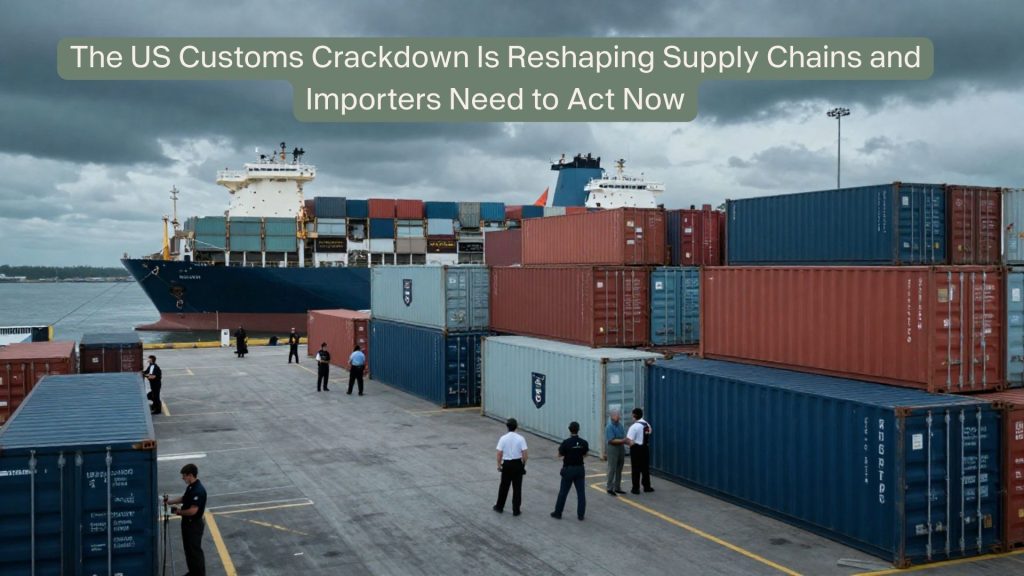
The landscape of US customs enforcement has shifted dramatically. With the president’s executive order Strengthening Customs Enforcement now in effect, the Department of Homeland Security has been directed to revise importer obligations, increase penalties, and tighten compliance requirements across the board. For anyone importing goods into the United States, the message is clear: the rules have changed, and the window to prepare is closing fast.
This is not a distant threat or a proposal working its way through bureaucratic channels. Executive orders have already been signed. Customs and Border Protection is receiving new funding for technology and enforcement personnel. Trade lawyers and customs brokers across the country are urging clients to take immediate action. The going is about to get much tougher for those who bring goods across the border.
The executive order targets several practices that have become commonplace in international trade. Among the most significant changes is a crackdown on tariff avoidance strategies that many importers have relied on for years. Companies that have minimized duties through classification engineering, undervaluation, or transshipment routes will find themselves under far greater scrutiny. The rules governing penalty reductions are also being tightened, meaning that even well intentioned importers who make honest mistakes may face steeper consequences than they did in the past.
One of the most talked about developments is the increased investment in artificial intelligence at CBP. The agency is deploying advanced machine learning systems to analyze shipping data, flag anomalies, and identify patterns that suggest noncompliance. Where human reviewers once had to manually sift through mountains of paperwork, AI can now process millions of records in seconds, cross referencing bills of lading, customs entries, and supply chain documentation with a level of precision that was previously impossible. For importers, this means that discrepancies that might have slipped through a manual audit are now far more likely to be caught.
The implications are profound. An incorrect tariff classification that once resulted in a modest penalty and a corrective filing could now trigger a full scale investigation. A missing certificate of origin that might have been overlooked in the past could hold an entire shipment at the border. The era of assuming that customs errors will simply result in a gentle correction is over.

Importers in the steel and aluminum sectors are facing an especially steep climb. New tariff exemption processes under Section 232 require applicants from Canada and Mexico to commit to verifiable US capacity expansion plans and maintain meticulously traceable records. The documentation burden has intensified significantly, and companies that cannot produce clean, auditable supply chain data will struggle to qualify for reduced rates. This is not a paperwork exercise it is a fundamental shift in how eligibility for tariff relief is determined.
The cost of noncompliance is rising rapidly. Penalties are being increased across the board, and the ability to negotiate reductions through voluntary disclosures is being restricted. The old calculation that it might be cheaper to pay an occasional penalty than to invest in robust compliance infrastructure no longer holds. When penalties are higher and the likelihood of detection is greater thanks to AI enhanced enforcement, the math changes decisively in favor of investing in compliance now.
So what should importers be doing today? First, conduct a thorough audit of your customs entries, classifications, and valuations for the past three years. Identify any areas where your practices might not align with current regulatory expectations. Second, invest in data quality. Your systems need to produce clean, consistent, and traceable records that can stand up to scrutiny. Third, review your relationship with your customs broker. Not all brokers are equally prepared for this new environment. You need a partner who understands the heightened enforcement posture and has the technology and expertise to help you navigate it.
Another critical step is to review your supply chain documentation processes. Certificates of origin, bills of lading, commercial invoices, and packing lists must all be accurate, consistent, and readily accessible. In an environment where AI systems are flagging discrepancies automatically, even small errors can cascade into significant problems. Consider implementing automated documentation validation tools that catch inconsistencies before your entries are filed.
The tariff landscape itself is also evolving in ways that directly affect pricing. When tariffs increase, there is no magic way to absorb those costs without passing them on. The idea that importers can simply eat the cost of higher duties has been tested and found wanting. Prices will rise, and companies that have not modeled the impact of tariff increases on their margins will find themselves scrambling.

The bottom line is that US customs enforcement is undergoing a fundamental transformation. Artificial intelligence, stricter penalty regimes, tighter importer obligations, and new tariff exemption requirements are converging to create an environment where compliance is no longer optional or negotiable. Importers who act now can position themselves ahead of the curve, while those who wait will face mounting costs, delayed shipments, and escalating legal exposure. The time to act is not next quarter or next year. It is today.