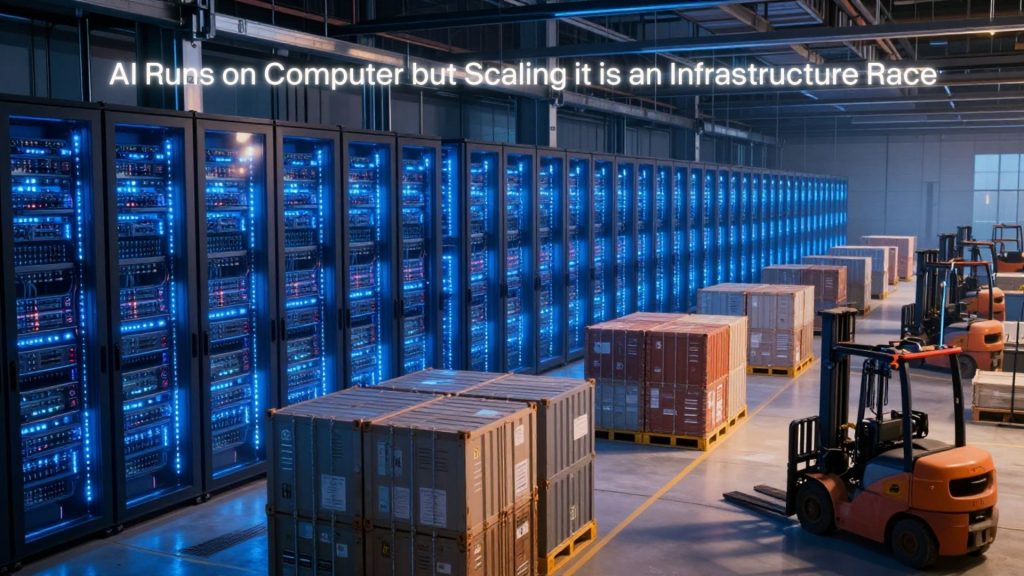
When people talk about artificial intelligence, the conversation almost always centers on the technology itself. Better GPUs, larger models, more training data, breakthrough algorithms, and top AI talent dominate headlines and venture capital pitches. But a quieter, more consequential transformation is underway behind the scenes. The companies that win the AI race will not necessarily be those with the most advanced models or the deepest research benches. They will be the ones that master the physical infrastructure logistics required to build, power, and connect the data centers that make AI possible.
The scale of current AI infrastructure buildout is nearly impossible to comprehend. Across Europe and the Middle East, more than 500 data center projects have been formally announced. Combined, these facilities would demand many gigawatts of electricity enough to power entire cities. But here is the catch that supply chain professionals understand immediately: announcements are not the same as completed projects. A growing gap has opened between what has been declared and what can actually be delivered, and the bottleneck is not chip supply alone.
Every new AI data center requires an extraordinary volume of material inputs that the global supply chain was never designed to produce at this speed. Power transformers, which step down high voltage electricity from the grid to usable levels for servers, now carry lead times of eighteen to twenty-four months. Manufacturers of these massive electrical components never anticipated the current wave of demand, and their production capacity cannot scale overnight. Companies that reserved GPU capacity months ago are now discovering that their data center shells sit empty waiting for electrical equipment that has not yet left the factory floor.

Cooling infrastructure presents another critical pinch point. The latest AI accelerators generate enormous amounts of heat, far exceeding what conventional air conditioning can handle. Advanced liquid cooling systems, including direct-to-chip and immersion cooling, require specialized pumps, piping, heat exchangers, and dielectric fluids that the broader industrial supply chain produces in limited volumes. Every new data center competes not just with other AI builders for this equipment but with pharmaceutical, chemical, and industrial manufacturing sectors that rely on the same precision cooling components.
The energy supply picture adds yet another layer of complexity. Major energy companies have begun striking direct deals with technology giants to power AI infrastructure. One notable project aims to deliver dedicated natural gas fired electricity to a major data center campus in Texas, effectively bypassing the strained public grid. These arrangements signal a fundamental shift in how AI infrastructure will be powered. Rather than relying on utility companies to build new generation capacity on their own schedules, hyperscale AI operators are increasingly taking energy supply into their own hands through power purchase agreements, captive generation, and even direct investments in nuclear energy.
The nuclear dimension is particularly striking. Recent government loan commitments totaling billions of dollars aim to accelerate new reactor construction by as many as three years, with the explicit goal of powering the next generation of AI data centers. Whether this timeline holds remains an open question. Nuclear construction has a long and well documented history of delays and cost overruns. But the direction of travel is unmistakable. The AI industry needs so much reliable, carbon free baseload power that it is now seriously pursuing energy sources that were considered impractical for private sector technology companies just a few years ago.

Fiber optic connectivity is the final piece of the physical puzzle. Every data center needs high bandwidth connections to the wider internet backbone, and the cable laying vessels that deploy submarine and terrestrial fiber routes are booked years in advance. Companies that failed to reserve fiber capacity during their data center planning phase are now scrambling to find available routes, often paying significant premiums for whatever bandwidth remains unclaimed. The digital layer that makes AI services accessible to users depends entirely on this physical substrate of glass and copper, and that substrate has its own supply chain constraints.
The core insight is that AI scaling has become a supply chain problem disguised as a technology problem. When organizations focus exclusively on GPU availability and model architecture improvements, they overlook the fact that none of that compute matters if the data center has no transformers, no cooling, no power, and no fiber connectivity. The winners in this next phase of AI development will be organizations that treat infrastructure logistics as a first class strategic priority, building supply chain expertise alongside their engineering talent.
This shift has profound implications for how companies evaluate their AI strategies. The era of assuming that any organization can simply order GPUs and start training large models is ending. Physical constraints around data center construction timelines, electrical equipment availability, cooling system production capacity, energy supply, and fiber optic connectivity now define the real pace of AI progress. The companies that recognize this reality and invest in logistics capabilities will have an advantage that no amount of algorithmic innovation alone can overcome. In the race to scale artificial intelligence, the decisive battles will be fought not in code repositories but in transformer factories, power plants, cooling equipment assembly lines, and cable laying vessels in the deep ocean.