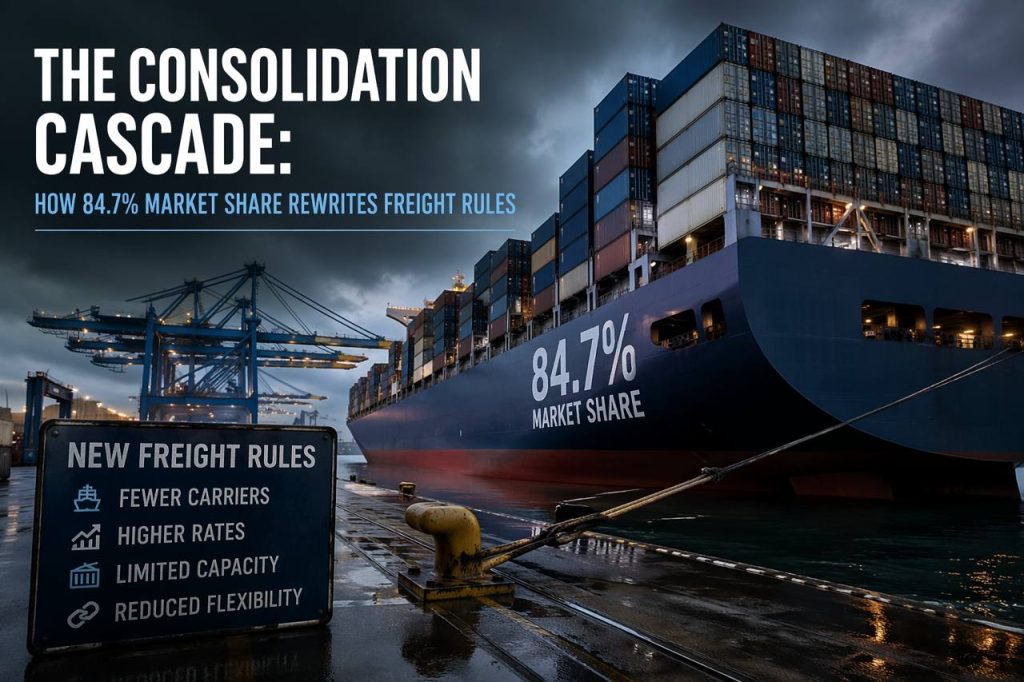
The global container shipping industry has reached a level of concentration that would have seemed unthinkable just a decade ago. The top ten ocean carriers now control 84.7 percent of global container capacity, and Mediterranean Shipping Company (MSC) has become the first operator in history to break the 20 percent market share barrier on its own. These numbers are not just statistical milestones. They represent a fundamental shift in the balance of power between carriers and shippers, with implications that ripple through every link in the global supply chain.
The Number That Changes Everything
Eighty four point seven percent. That is the combined market share held by the ten largest container lines as of early 2026. To put that in perspective, just five years ago the same group controlled roughly 75 percent. The nine percentage point increase represents a massive transfer of capacity and negotiating leverage into fewer and fewer hands. The alliance structure that governs most East West trade lanes means that even where carriers compete on paper, they coordinate on schedules, port calls, and capacity deployment. For shippers, the pool of genuinely independent options is shrinking fast.
MSC’s Solo Record and What It Signals
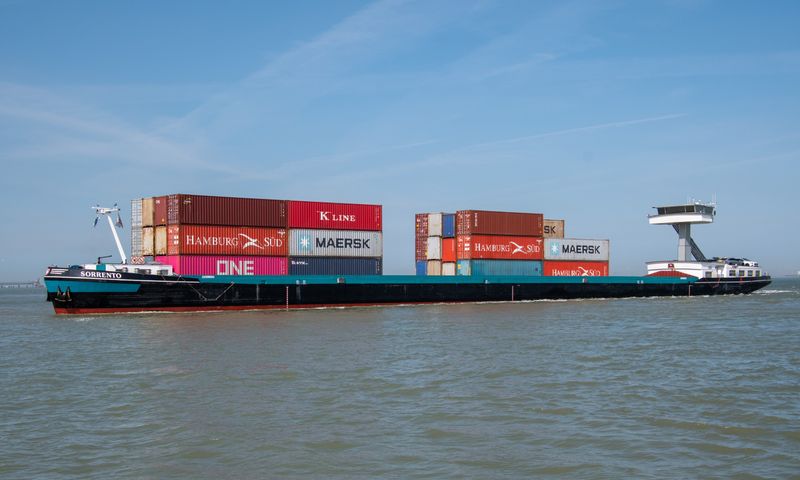
MSC crossing the 20 percent threshold on its own is the most telling indicator of where the industry is heading. No single carrier has ever held that much capacity independently since the era of mega mergers began. Unlike the top two carriers that merged into a single entity, MSC has grown organically through aggressive fleet expansion and strategic secondhand vessel purchases. The company now operates more than 850 vessels with a total capacity exceeding 6 million TEUs. That scale brings cost advantages that smaller competitors simply cannot match. It also gives MSC outsized influence over freight rates on every major trade lane where it operates.
The question for shippers is not whether this concentration matters, but how to navigate it. When a single carrier controls one in every five containers moving by sea, that carrier’s commercial decisions become market events. Rate increases, blank sailings, and capacity reallocations by MSC affect everyone, not just its direct customers. The days when shippers could play multiple carriers against each other for competitive quotes are fading. The leverage has shifted, and it has shifted permanently.

Rates in a Concentrated Market
The most immediate impact of market concentration is on freight rates. In a fragmented market, excess capacity drives rates down as carriers compete for volume. In a concentrated market, the dynamic reverses. The top carriers can manage capacity more effectively, matching supply to demand with surgical precision. Blank sailing programs that would have been impossible to coordinate across dozens of independent lines are now routine. When the top ten carriers control nearly 85 percent of capacity, they do not need a formal cartel to align behavior. Market discipline emerges naturally from the interdependence of their networks.
This does not mean rates will rise in a straight line. Seasonal fluctuations, geopolitical disruptions, and demand shocks will still create volatility. But the floor has lifted. Even in periods of weak demand, carriers have demonstrated a willingness to idle capacity rather than cut rates to unsustainable levels. That discipline was largely absent in previous decades. For shippers, the implication is that rate negotiation has become a fundamentally different exercise. Historical benchmarks and long term averages are less relevant. The question is not whether rates will return to pre pandemic lows, but what the new normal looks like and how to build contracts that reflect it.
Reliability vs Resilience in a Concentrated System
Market concentration has a paradoxical effect on service reliability. On one hand, larger carriers with more vessels and broader networks can offer more consistent schedules and diversified routings. When one vessel breaks down or a port congests, a mega carrier can reroute cargo through alternative hubs with minimal disruption. On the other hand, concentration creates single points of failure. If one of the top three carriers experiences a systemic operational problem a terminal dispute, a IT failure, or a financial stress event the ripple effects are magnified across the entire supply chain because so many shippers depend on that carrier’s network.
The resilience question goes deeper than operational risk. When carriers coordinate capacity through alliances, the diversity of independent decision making that historically protected supply chains begins to erode. If all major carriers respond to a disruption in the same way because they face the same capacity constraints and market incentives the system becomes brittle. True resilience requires diversity. Diversity of routes, diversity of carriers, and diversity of commercial models. A market where three alliance groups control virtually all East West capacity does not offer that diversity, regardless of how operationally efficient each alliance may be.
What Shippers Can Do
Shippers cannot reverse the trend toward consolidation, but they can adapt their strategies to it. The first step is recognizing that the old negotiation playbook no longer applies. Long term contracts with volume commitments still have value, but they need to include more sophisticated rate adjustment mechanisms, service level guarantees, and contingency provisions for disruption scenarios. The second step is diversifying the carrier base not just across the top ten, but across alliance groups. If all contracted carriers belong to the same alliance, the diversification is more apparent than real. Independent carriers and regional operators, while limited in capacity, offer a valuable hedge against alliance level disruptions.
The third step is investing in visibility and flexibility. In a market where carriers hold more leverage, shippers need better data on their own supply chains to make informed decisions. Knowing exactly what cargo is moving, on which vessels, and through which ports allows shippers to optimize routing and reduce dependency on any single carrier or trade lane. The fourth step is exploring alternative transport modes where feasible. Rail, airfreight, and regional trucking may not replace ocean shipping for volume, but they can serve as strategic buffers when ocean capacity tightens or rates spike.
The New Reality
Container shipping has entered an era of permanent concentration. The 84.7 percent market share held by the top ten carriers is not a cyclical peak that will reverse when market conditions change. It is the structural outcome of two decades of mergers, acquisitions, and organic growth by the largest players. MSC’s 20 percent solo milestone is a symbol of that new reality. For shippers, the path forward is not about fighting the trend but adapting to it. Those who update their procurement strategies, diversify their carrier networks, and invest in supply chain visibility will be better positioned to navigate the concentrated landscape. Those who rely on outdated assumptions about carrier competition will find themselves with diminishing leverage and increasing exposure to risk.