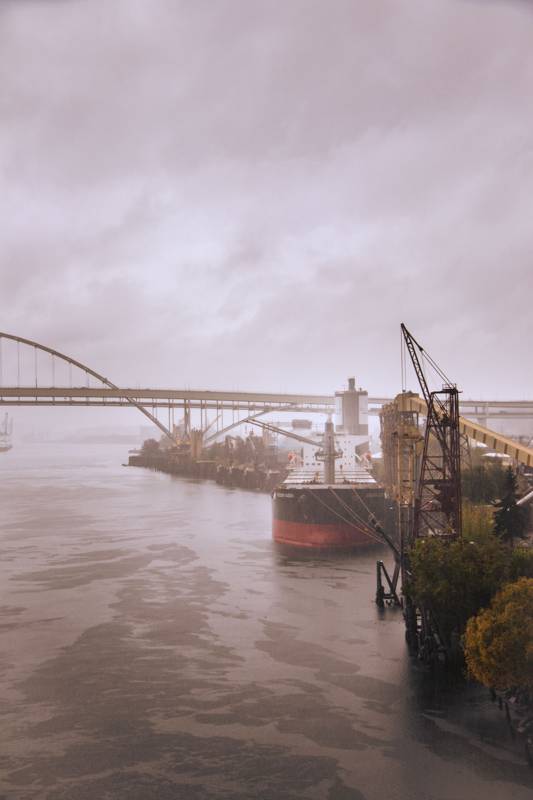
A container ship just sailed from South Korea to Rotterdam through the Arctic. On the same day, barge traffic on the Rhine River, Europe’s busiest inland waterway, ground to a near halt because there was not enough water to float the vessels. Two stories from opposite ends of the map. One planet. The same underlying force reshaping them both.
The old supply chain risk manual assumed disruptions were independent events: a port strike here, a factory fire there, a weather anomaly somewhere else. That manual is now obsolete. When the Rhine dries up and the Northern Sea Route opens up simultaneously, these are not separate incidents. They are two expressions of a single, accelerating trend. Climate change is redrawing the map of global shipping faster than risk models can update themselves.

The River That Refuses to Cooperate
The numbers from the Rhine are stark and getting starker. Contargo, one of Europe’s largest container logistics operators, now reports critical low water levels at all four of its monitored gauges. Barges that normally carry 3,000 tons are loading at 30 percent capacity just to stay afloat in the shallows. Every container left behind on the riverbank is a container that moves by truck instead, at triple the cost and five times the carbon output.
Consider the planner at a German automotive supplier. Her factory sits 800 kilometers from Rotterdam, and for years her inbound schedule was a quiet, predictable rhythm. Components arrived by barge every Tuesday. Today she starts her mornings refreshing water level forecasts at Kaub, the Rhine’s most unforgiving choke point. Below 40 centimeters on the gauge, a fully loaded barge cannot pass. She is already rerouting to rail, paying spot premiums, and explaining to her production director why next week’s potential line stoppage is not her fault. It is the river’s fault. And the river answers to nobody.
This is not a drought cycle that will pass. It is a structural shift in the reliability of inland waterways. Maersk sees the writing on the dry riverbed. The carrier has been aggressively building capacity on the busy intra-North Europe trade, while smaller rival Samskip saw its market share cut in half by competitor CLdN. When rivers become unreliable, short-sea shipping gains leverage, and the biggest players are positioning themselves to capture the rerouting premium.

The Ice Highway Opens
Three thousand nautical miles to the north, an entirely different kind of disruption is unfolding. PanStar’s maiden Northern Sea Route voyage from Busan to Rotterdam, Hamburg, and Gdansk has captured the attention of South Korean exporters for a simple reason: the Arctic route cuts transit time by up to 40 percent compared to the Suez Canal. What was once a theoretical shortcut discussed at academic conferences is now a ship with cargo on it, docking at real European ports.
The irony is almost too neat. The same warming that evaporates the Rhine is melting the Arctic ice. One waterway closes. Another one opens. The geography of global trade is shifting beneath our feet, and most supply chain risk assessments still treat “weather disruption” as a single line item on a quarterly review slide.
The Volatility Baseline Has Changed
The Drewry World Container Index now exhibits what analysts call a Fortnight Brace pattern: double-digit spot rate spikes one week followed by flat or low single-digit changes the next. The overall index trends downward, but the amplitude of the swings keeps widening. Planning a logistics budget in this environment is like trying to balance a spreadsheet on a trampoline.
CMA CGM’s latest results capture the contradiction perfectly. The shipping line posted a booming second quarter, riding strong container demand and elevated freight rates. Yet beneath the headline numbers, its logistics subsidiary Ceva saw EBITDA improve while margins remained stubbornly thin. You can own the ships, the boxes, and the terminals, and still struggle to turn a profit on the ground where the real complexity lives. The value is migrating from asset ownership to network intelligence.
Redrawing the Risk Map
The old geography of supply chain risk was fixed. Certain chokepoints always mattered: the Strait of Hormuz, the Panama Canal, the Suez. The new geography is fluid. Literally. Rivers that were reliable for centuries become seasonal uncertainties. Ice sheets that were barriers for millennia become commercial shipping lanes. The risk map is no longer a document you update annually. It is a live feed you monitor daily.
This demands a different kind of planning muscle. Not just scenario planning that asks “what if the Rhine drops?” and “what if the Arctic opens?” as separate hypotheticals. But a single question: what does my supply chain look like when both happen at once? Because that is no longer a hypothetical. That is this month.