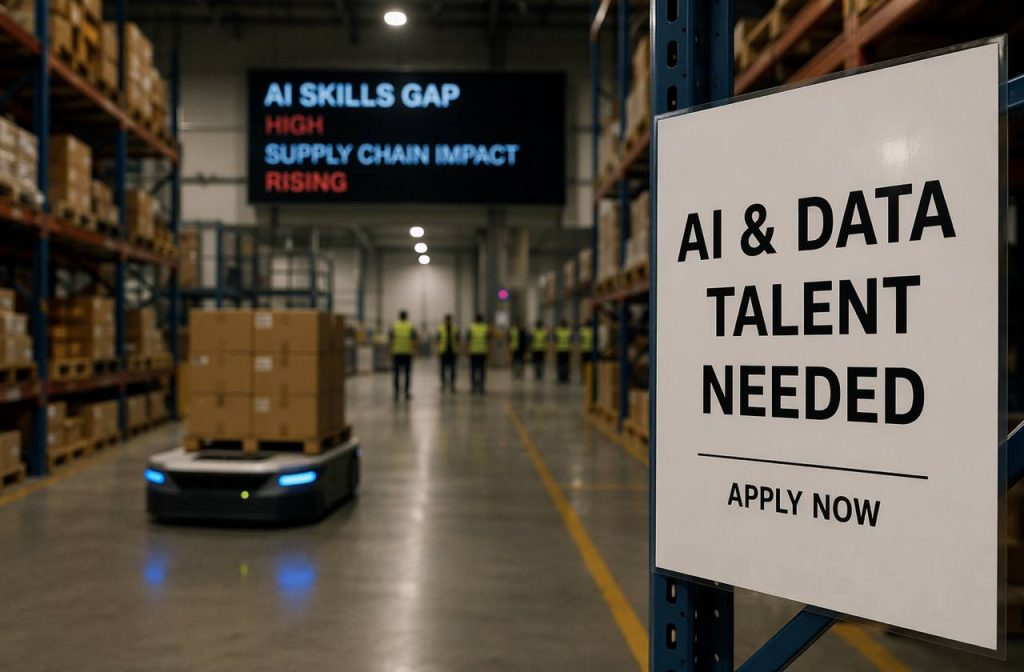
Every supply chain leader has heard the message by now: artificial intelligence is not coming, it is already here. From demand forecasting to warehouse robotics, AI promises to reshape how products move from raw material to customer. But as companies rush to adopt these technologies, they are hitting a wall that no software license can fix. The wall is talent.
Gartner recently reported that demand for AI skilled supply chain roles has grown significantly faster than the overall labor market. This is not a niche problem. It cuts across planning, procurement, logistics and operations. And the numbers paint a clear picture: hiring alone will not close this gap. The traditional approach of posting a job description, waiting for applications and selecting the best candidate is failing because the candidates do not exist in sufficient numbers. The pool of professionals who understand both supply chain mechanics and AI/ML tools is startlingly small.
The Gap Is Structural

To understand why hiring cannot solve the problem, look at what AI in supply chain actually demands. A demand planner who can also tune a neural network. A logistics manager who understands reinforcement learning for route optimization. A procurement specialist who knows how to build and validate a spend classification model. These are hybrid roles that blend domain expertise with technical fluency, and no university is producing them fast enough.
Gartner’s research underscores that organizations expecting to fill these roles through external recruitment are missing the point. The market simply does not have enough people. And even if it did, the time to onboard a supply chain professional with AI skills is measured in months, not weeks. The learning curve spans internal data structures, legacy systems, supplier relationships and the nuances of demand patterns that take years to internalize.
This is where the most forward thinking companies are starting to diverge from the pack. Instead of trying to outbid each other for a tiny pool of candidates, they are building the talent they need through three parallel strategies: upskilling existing teams, forging technology partnerships and making platform bets that reduce dependency on scarce expertise.
Kimberly Clark’s Automation Led Productivity
Kimberly Clark, the maker of Kleenex and Huggies, offers a real world example of how platform and automation investments are already delivering results. The company is more than halfway through a five year, $3 billion productivity enhancement program launched in 2024. Executives at the dbAccess Global Consumer Conference earlier this month attributed much of the progress to three supply chain components: simplifying the value stream, optimizing its network and scaling automation.

CFO Nelson Urdaneta highlighted that productivity improvements in the last two years came disproportionately from these supply chain initiatives. The company is investing in an automated distribution center within its South Carolina factory, the largest in the world, where robotics and AI powered logistics systems will drive efficiency gains starting in 2027.
Kimberly Clark’s approach shows that productivity does not require a massive AI hiring spree. It requires strategic capital allocation and a willingness to invest in platforms that embed intelligence directly into operations. The company expects further gains from its pending merger with Kenvue, where combined logistics networks will reduce transportation costs through better truck utilization and shared procurement scale.
This is the platform bet strategy in action: instead of hiring dozens of AI specialists, Kimberly Clark is buying AI powered systems and training its workforce to use them. The intelligence is in the platform, not in the headcount.
Grocery Outlet’s Platform Partnership Model
A different but equally instructive example comes from Grocery Outlet, the extreme value discounter operating approximately 550 stores across 16 states. The company announced this week that it is deploying Afresh’s AI powered ordering technology across all store categories, becoming the first retailer to use Afresh’s full store multi category system.
What makes this interesting is not the technology itself, but what it reveals about Grocery Outlet’s talent strategy. Rather than trying to build an in house AI team to develop custom ordering algorithms and demand models, the company chose a partnership model. Afresh provides the AI, the dashboards and the real time data. Grocery Outlet provides the domain expertise and operational knowledge.
The results speak for themselves. Across Afresh’s partnerships, retailers have seen workers cut ordering time in half while increasing sales by 3% and reducing shrink by 25%. The adherence rate of how closely operations align with planned targets stands at 94%.
For Grocery Outlet, whose quickly rotating assortment and independent operator model create unique complexity, the partnership approach solves two problems at once. First, it bypasses the need to hire AI engineers who also understand grocery retail. Second, it gives store operators tools that make their jobs easier without requiring technical training. The AI works in the background, flagging exceptions and surfacing recommendations. Store teams only need to review what the system flags as unusual.
This partnership model is increasingly viable because the AI platform ecosystem in supply chain has matured. Companies no longer need to build from scratch. Specialized vendors like Afresh, Blue Yonder, Kinaxis and others offer domain specific AI that can be deployed faster and more reliably than custom built solutions.
The Three Strategy Framework
Taken together, Kimberly Clark and Grocery Outlet illustrate the three strategy approach that supply chain leaders should be building today.
Upskilling existing teams is the most direct path. Gartner research consistently shows that organizations investing in internal training programs retain talent longer and achieve faster ROI on technology investments. A demand planner who learns to work with AI forecasting tools becomes exponentially more valuable. A warehouse supervisor who understands how to interpret and act on AI recommendations improves both efficiency and morale.
Partnerships are the fast track. No company needs to build its own AI from scratch. The vendor ecosystem has matured to the point where best in class solutions exist for demand planning, inventory optimization, logistics routing, procurement analytics and warehouse management. The skill that matters is not building AI but selecting, integrating and managing AI partners effectively.
Platform bets are the long term foundation. Investing in AI powered platforms that embed intelligence into everyday tools reduces the dependency on scarce technical talent. When the ordering system itself learns demand patterns and makes recommendations, the operator does not need to be a data scientist. The intelligence is in the system.
The Cost of Waiting
The risk of inaction is growing. As AI becomes more embedded in supply chain operations, the gap between companies that have figured out the talent equation and those that have not will widen rapidly. The companies that treat AI adoption as a headcount problem will find themselves in a bidding war they cannot win. The companies that treat it as a capability building challenge will pull ahead.
The message from Gartner is clear. The gap cannot be closed by hiring alone. It requires a deliberate strategy that combines internal development, external partnerships and platform investments. The companies that act on this insight today will be the ones leading their industries when the next wave of AI innovation arrives.