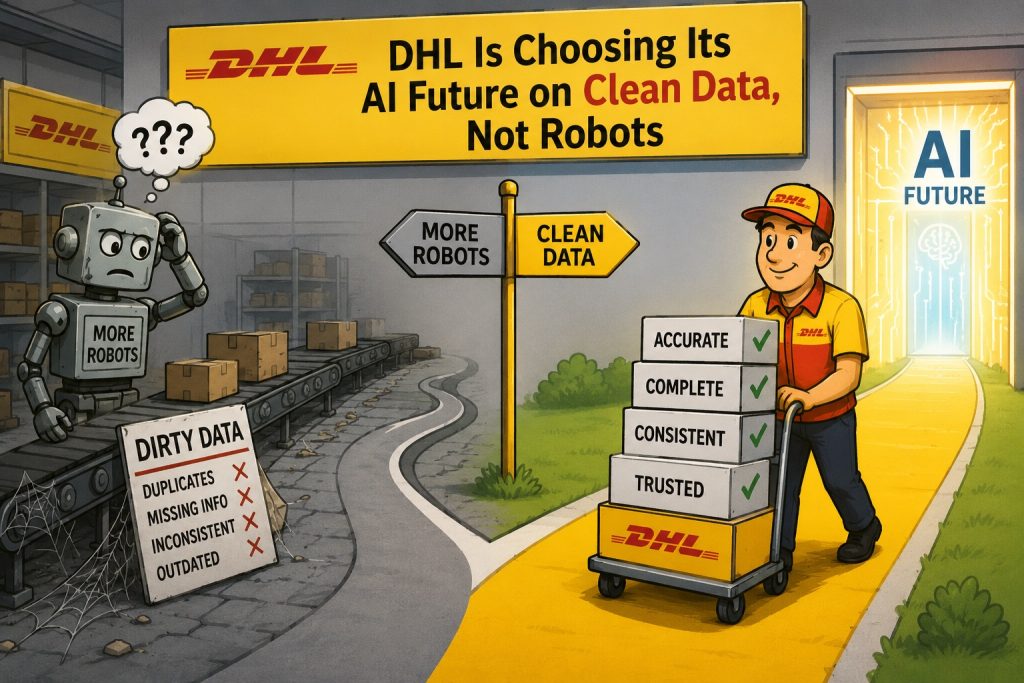
There is an assumption taking hold across supply chain media. It goes something like this: deploy robotics in the warehouse, layer on analytics dashboards, sprinkle in some agentic AI, and the future of logistics will arrive. The tone is breathless. The headlines promise transformation. And behind the scenes, most of these initiatives are quietly failing.
DHL Supply Chain recently made an argument that cuts against the grain of this narrative. In a piece published by Supply Chain Management Review, the company’s leadership laid out a counterintuitive thesis. The path to AI driven supply chain growth does not begin with flashy automation. It begins with something much more mundane: clean, normalized, well structured operational data.
This is a hard sell in an industry that loves shiny things. Forklifts that drive themselves. Software agents that negotiate with suppliers. Predictive models that flag disruptions before they happen. All of it is exciting. None of it works without a data backbone that most companies do not have.
The Data Maturity Gap
The phrase “data quality” sounds like a problem for the IT department. In practice, it is the single largest barrier to AI adoption in logistics. Consider what happens when a warehouse management system, a transportation management system, and an ERP all record the same shipment with three different product codes. The AI sees three different products. It trains on noise. It predicts garbage.
DHL’s argument is that data quality maturity, not robotics spending, will determine which supply chains actually benefit from AI. A company with mediocre automation and excellent data will outperform a company with world class robots and fragmented data every time. The robots are execution tools. The data is the brain. And a disconnected brain cannot drive anything.

What Data Quality Maturity Looks Like
Data quality maturity in logistics is not a single metric. It is a spectrum with recognizable stages. At the lowest level, data exists in silos. The warehouse runs its own numbers. The procurement team runs theirs. No one reconciles. Forecasts are built on spreadsheets that travel by email. This is where most companies live.
The next stage is standardization. Product codes, location identifiers, and unit of measure conventions are aligned across systems. A pallet in Singapore and a pallet in São Paulo use the same naming logic. This stage is painful. It requires people from different functions to agree on definitions. It requires political capital, not just technical investment.
At the next stage, data is not only clean but connected. Inventory systems talk to procurement systems. Forecast updates flow into warehouse planning automatically. The number of spreadsheets declines. Teams start trusting the numbers because they no longer find three different versions of the same metric.
At the highest stage, data is not only standardized but governed. There are rules about who changes what. There are audit trails. There is an understanding that data is an operational asset, not an administrative byproduct. This is the stage where AI has a chance to deliver real returns because the models are learning from signal, not noise.
Why Most Companies Will Fail Before They Start
The uncomfortable truth is that most companies will not reach the second stage before their AI initiative runs out of runway. The typical pattern goes like this: a leadership team reads about AI in supply chains. They hire a data science team. They buy a platform. They run a pilot on a small subset of clean, curated data. The pilot looks promising. Then they try to scale. The data from the rest of the organization hits the models like a wall. The models break. The data science team burns out. The initiative is declared a learning experience.

This is not a technology failure. It is a data readiness failure. The pilot worked because the data was hand selected and manually cleaned. Scale failed because the operational systems feeding the model were never normalized. The AI never had a chance.
The Boring Competitive Advantage
Investing in data foundations is not glamorous. No one gets a standing ovation for aligning part numbers across three ERPs. No conference keynote is built around a master data management project. But these unglamorous investments are precisely what separates the companies that successfully adopt AI from the ones that waste millions on pilots that never scale.
DHL’s bet is worth watching because it acknowledges something that the hype cycle prefers to ignore. The real competitive edge in the age of agentic AI is not who has the most robots. It is who has the cleanest data. The robots will be commodity technology within a decade. The normalized, governed, trusted data foundation will take much longer to build and much harder to replicate.
The Bottom Line
If your supply chain is considering an AI initiative, start with an audit. Not of your technology stack, but of your data. Pick a single process, a single geography, and trace the data from source to consumption. Count how many transformations, manual entries, and reconciliations occur along the way. That number is roughly inverse to your probability of AI success.
Clean the data first. Then automate. The robots can wait.