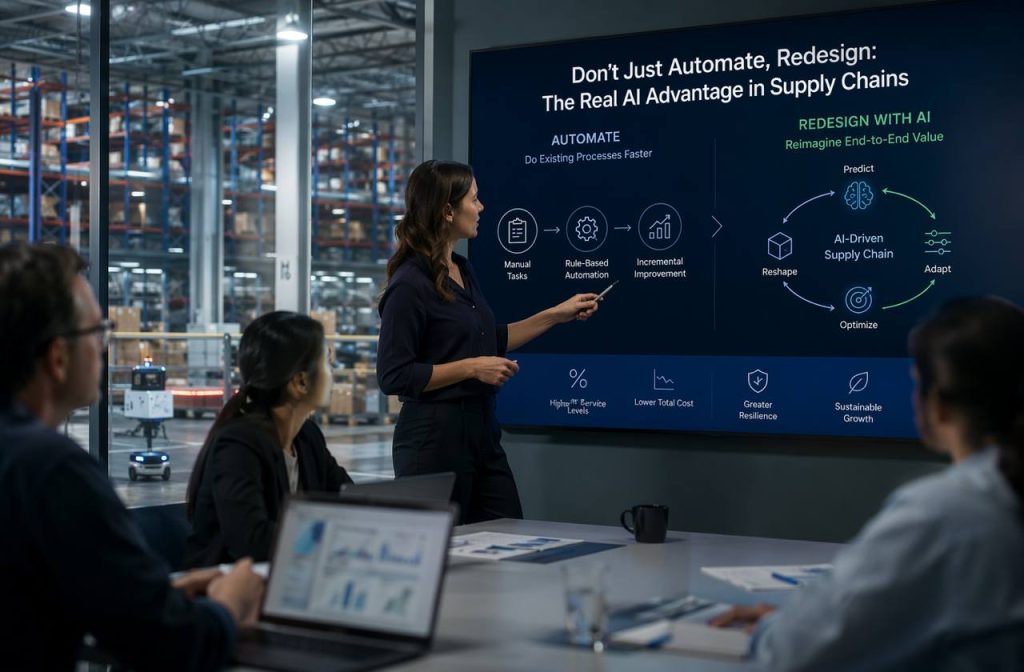
Most companies approach AI in supply chain the same way they approached email automation in the 1990s: they take an existing process, add a software layer on top, and call it transformation. Stack an AI forecasting tool on an old demand planning workflow. Drop a chatbot onto an outdated customer service process. Then wonder why efficiency gains never materialize.
AI does not deliver breakthrough results when used to speed up broken processes. It delivers them when it forces organizations to redesign how work gets done from the ground up.
The Difference Between Automation and Redesign
Process automation takes a defined workflow and runs it faster. If you have a supply chain team that spends three days generating a weekly demand forecast, automation can compress that to three hours. That is a genuine improvement. But the forecast itself is still structured the same way, reviewed in the same weekly meeting, and acted on with the same decision hierarchy as before. The fundamental architecture of decision making has not changed.
Work redesign, by contrast, asks a more ambitious question: If we had AI from day one, would we have built this workflow at all? Would we still organize demand planning around weekly batch cycles, or would we operate in continuous, exception driven mode? Would we still escalate every supply disruption through four layers of management, or would frontline teams have direct access to predictive intelligence?
These are not incremental questions. They challenge the organizational structures, role definitions, and power dynamics that supply chains have operated under for decades.
What Redesign Looks Like in Practice
Consider how global ports and terminal operators are beginning to use AI. In a traditional container terminal, vessel planning, yard allocation, and gate operations are managed by separate teams with separate systems. Handoffs between these teams are where delays multiply. A vessel planner decides berth assignment. The yard operator then adjusts container stacking based on that decision. The gate operator reacts to both.
AI driven terminal operating systems change this entirely. Instead of optimizing each function independently, a unified intelligence layer coordinates vessel scheduling, yard stacking, and gate flow simultaneously, adjusting in real time as conditions change. The terminal operator’s job shifts from making point decisions to managing exceptions that the system surfaces. The role itself is redesigned, not just sped up.
Adani Ports, one of the largest port operators in India, has committed up to $100 million to deploy integrated AI software across 15 container terminals at 9 ports. The investment is part of a broader $850 billion technology and decarbonization push, aiming to handle one billion tonnes of cargo annually by 2030. This is not automation of existing terminal processes. It is a structural redesign of how terminal operations are managed and optimized.
The Three Layers of AI Driven Redesign
Organizations that succeed in moving from automation to redesign transform across three layers.
Layer one: Decision architecture. The most common mistake is to replicate human decision hierarchies inside AI systems. If a supply chain currently requires regional managers to approve inventory rebalancing above a certain threshold, companies often encode that same rule into their AI tool. But AI thrives in environments where decisions are distributed to the point of action. Redesign means asking which decisions can be made autonomously at the front line, which require human judgment, and how those two modes interact.
Layer two: Workflow structure. Batch oriented supply chains are built on a weekly or monthly planning rhythm. Forecasts are generated Monday, reviewed Wednesday, and executed Thursday. This cadence exists because manual processes cannot keep up with real time data. AI eliminates that constraint. Redesign means shifting from batch to continuous where it makes sense, triggering action on exception signals rather than calendar dates.
Layer three: Talent and roles. Work redesign inevitably changes what people do. When AI handles routine decisions, planners shift from number crunchers to scenario analysts. When predictive models surface disruptions before they happen, procurement teams shift from firefighting to strategic sourcing design. Organizations that fail to redesign roles alongside processes end up with frustrated teams and underutilized AI investments.
Why Most Companies Stop at Automation
The barrier is not technological. AI models for demand sensing, inventory optimization, and logistics routing are mature and accessible. The barrier is organizational. Redesigning workflows means reassigning responsibilities, changing reporting structures, and in many cases reducing headcount in functions where AI has made manual work obsolete. These are difficult conversations that most leadership teams prefer to postpone.
There is a cultural attachment to familiar rhythms. The weekly S&OP meeting, the monthly business review, the quarterly financial forecast. These cadences are comfortable. But AI was not designed to make comfortable processes slightly faster. It was designed to make possible what was previously impossible.
The Shift from Transactions to Transformations
Supply chain history follows a pattern. The 1990s were about transaction efficiency with ERP systems. The 2000s were about visibility through control towers. The 2010s were about analytics with dashboards and KPIs.
The current decade is about something different. AI makes it possible to connect operational actions directly to business outcomes. A demand signal from a retail partner can trigger an automated replenishment decision that adjusts production schedules, logistics routing, and inventory targets in one coordinated response. This is not a faster version of the old process. It is a fundamentally different way of running a supply chain.
Companies that treat AI as a layer on top of existing processes will capture incremental gains. Companies that use AI as a reason to redesign how they make decisions will capture the market. The difference between the two is not about technology. It is about the courage to ask the harder question.