On 17 June 2026, logistics operators across multiple continents found themselves staring at login error screens instead of shipment data. CargoWise, the flagship platform of WiseTech Global, had gone dark. The cause, according to WiseTech, was a faulty data update that triggered login exceptions across the platform, effectively locking users out of their own supply chain operations for several hours.
But the outage itself is only part of the story. What makes this incident significant is not the two-hour downtime window, but what it reveals about the growing dependency of global logistics on single software platforms and the fragility that comes with it.
The Single Point of Failure Problem
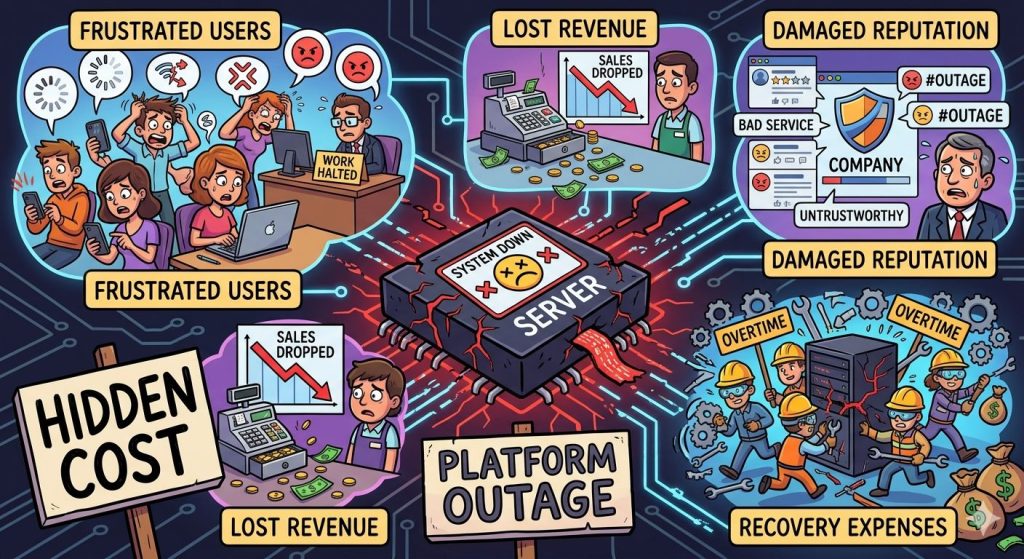
When a forwarder builds its entire operational workflow around a single platform, that platform stops being a tool and becomes infrastructure. Just as a power grid failure stops a factory, a software outage stops a freight forwarder. CargoWise customers reported that the disruption went beyond simple login issues. Workflow triggers failed, messaging services broke down, and even after service was restored, process controllers had to be manually restarted and workflows reprocessed.
This is the hidden cost of deep platform integration. The more tightly your operations are woven into a software ecosystem, the more disruptive any interruption becomes, regardless of duration. A two-hour outage can cascade into half a day of remediation work, reprocessing, and manual interventions.
Quality versus Velocity
Perhaps the most telling detail in the aftermath was not the outage itself, but what customers said about the broader trend. One customer described the build quality of recent updates as having gone completely downhill, with random errors and issues for things that were never a problem in the past. Another pointed to the accelerated release cadence following the introduction of CargoWise Value Packs, with updates arriving more frequently and with less advance notice than under previous cycles.
This tension between innovation velocity and software stability is not unique to WiseTech. Every platform company faces the same dilemma: customers demand new features, but they also demand reliability. Push updates too slowly and competitors eat your lunch. Push them too fast and you erode the trust that keeps customers locked in.
The Support Gap
Reactions to WiseTech’s handling of the outage were mixed. Some customers praised the direct communication from CargoWise’s CEO, who personally engaged with affected users. The managing director of one UK forwarder noted that while the Value Packs rollout was far from smooth, the CEO stood up when many thought he would hide away.
But others reported a different reality: support responsiveness described as almost non-existent, a shift from proactive to reactive support, and a self-help model that leaves customers feeling abandoned when things go wrong. The contrast is striking. A CEO can personally reassure a handful of high-profile clients, but the broader support experience tells a different story.
For enterprise software, support is not a nice-to-have feature. It is the safety net that catches customers when things break. When that net develops holes, confidence erodes quickly.
The Dominance Paradox
Despite the growing frustration, WiseTech continues to win. As one customer put it: despite the price hikes, service issues, and outages, WiseTech is still winning medium and large forwarders. No one is yet making a dent in their dominance.
This is the dominance paradox in enterprise software. Even when customers are unhappy, switching costs are often so high that leaving is impractical. Migrating a freight forwarding operation from CargoWise to an alternative platform is not a simple data export. It means retraining teams, rebuilding integrations, reconfiguring workflows, and accepting months of productivity loss. For most companies, the pain of staying is less than the pain of leaving, at least until a critical threshold is crossed.
What This Means for Supply Chains
The CargoWise outage is a reminder that digital transformation is not just about adopting powerful software. It is about understanding the risks that come with dependency. Every platform that becomes essential infrastructure for your operations should be evaluated not just on its features, but on its reliability, its support responsiveness, and its track record of maintaining quality under pressure.
The companies that thrive in this environment will be those that build resilience into their software strategy. Not by avoiding dominant platforms, but by understanding their vulnerabilities and planning for the moments when things go wrong. Because in supply chain management, the question is never if a platform will fail. It is whether you will be ready when it does.