
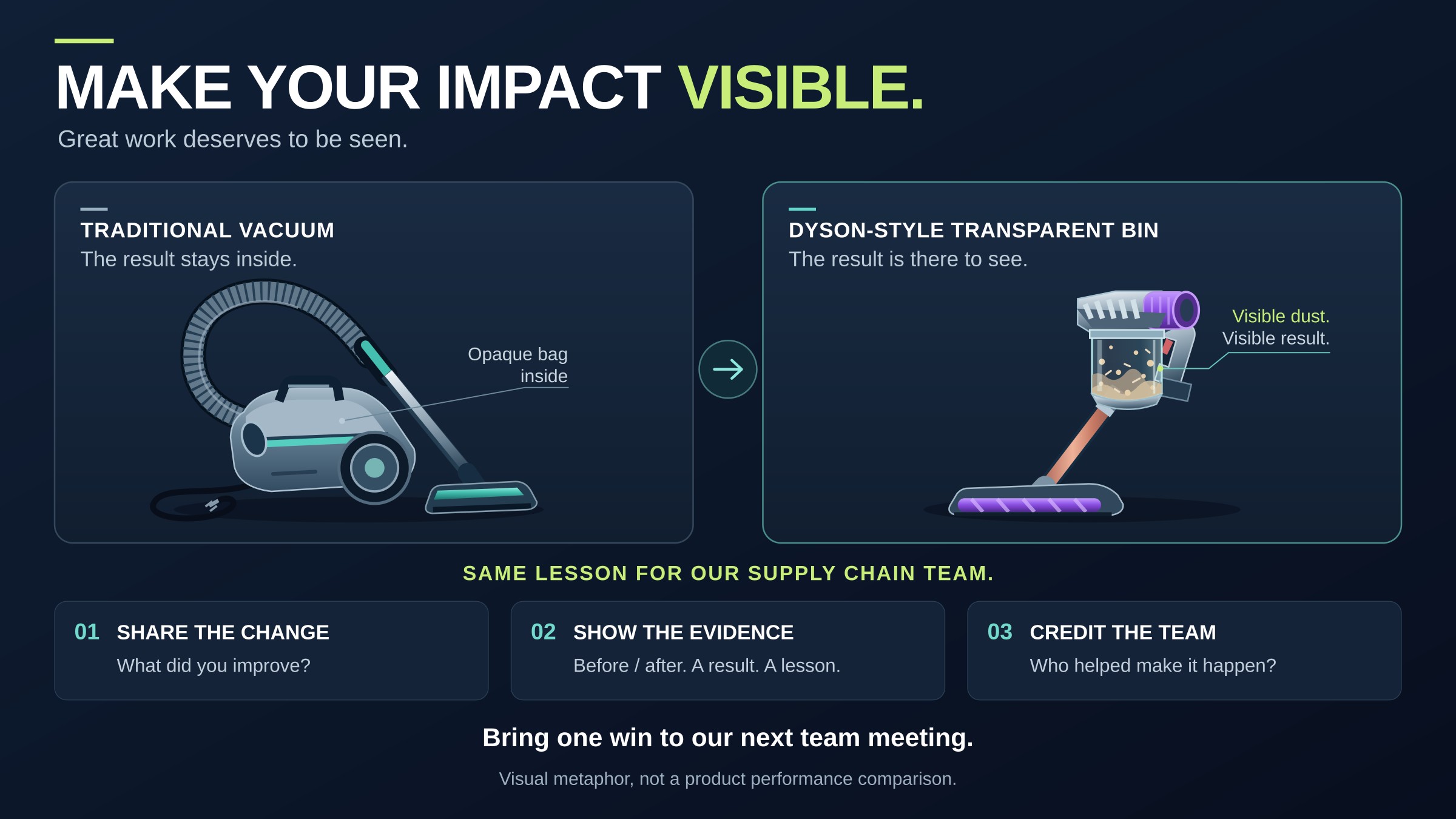
While doing the vacuum cleaning this Sunday, I noticed dust collecting in the transparent bin of a Dyson. The material gathered during the task was visible at a glance. An opaque vacuum bag would hide what it had collected, although that observation does not compare cleaning performance. It does offer a useful prompt for supply chain leadership: work that prevents disruption can be difficult to see, so the account of it needs care.
Make supply chain contribution visible through evidence, and share the credit.

Show what changed
Much of the most valuable supply chain work happens before a customer notices a problem. A team sees a developing stock risk, checks its cause, changes an order or sequence, follows up with a supplier, or coordinates a recovery before the effect spreads. When the operation stays stable, the effort can disappear into the background. Stability does not prove that nobody worked hard. It also does not prove that one intervention caused every good outcome.
Useful visibility is not personal promotion. It gives other people enough detail to understand what was exposed, who acted, what changed, and what remains uncertain. A final service level or inventory position may show an outcome while hiding the decisions and labor behind it. A concise account of the issue, action, observed outcome, supporting record, and remaining exposure gives leaders a better basis for judgment.
Managers should invite contributions from colleagues who do not naturally take the floor. They should assess evidence rather than polished presentations, and they should not reward the loudest voice or the person who arrives only for a dramatic recovery. Quiet work such as maintaining accurate records, spotting a pattern, or resolving a small dependency may be central to the result. Its value should not depend on how confidently it is presented.
Be honest about prevention
Illustrative example: A supplier flags a possible shipment delay. The team reviews the exposure, arranges a revised receiving slot with the warehouse and supplier, and the shipment is actually received inside the revised agreed window. That is observable evidence of coordinated delivery. It is not proof that a stockout would certainly have happened without the intervention.
A prevention account should document four things: the original exposure, the action taken, the observed outcome, and the unknown counterfactual. The record might include the supplier update, order history, revised receiving agreement, delivery confirmation, and notes from customer service. Supplier, warehouse, planning, procurement, and customer service may all deserve credit, even when one person writes the summary. The account should describe the contribution of each group without turning collaboration into a solo achievement.
This discipline matters when the outcome is favorable and when it is disappointing. A response that protects one customer promise may create pressure elsewhere. A faster shipment may increase handling complexity. A reduction in one exposure may leave another unresolved. Show those tradeoffs and open risks in the review. Do not convert an avoided possibility into realized savings, a guaranteed prevention, or a claim of success. Clear limits make the account more trustworthy.
Evidence can be modest. An exception log, order history, supplier message, service record, meeting note, or clear before and after explanation may be enough. The standard is not a large dashboard. The standard is whether another person can follow the reasoning and distinguish recorded facts from interpretation. That makes the account useful for a later decision, even when the counterfactual can never be observed.
Give the credit properly
Reviews often celebrate visible firefighting more readily than quiet prevention. A late escalation has a dramatic ending, while careful checking can look like routine administration. That imbalance can encourage teams to wait for emergencies because emergencies are easier to narrate. Managers can correct it by asking what was detected early, what evidence was gathered, which action changed the situation, and which risks remain. They should also ask who supplied the information, who coordinated the work, and who carried the operational burden.

Fair attribution is practical, not ceremonial. Name cross functional collaborators in the same place where the outcome is described. Solicit a quiet colleague’s account before the meeting ends. Check records rather than accepting the most polished explanation. If accounts conflict, preserve the disagreement and identify what needs checking. Credit should follow contribution and evidence, not visibility, hierarchy, or a talent for presenting.
At the next review, bring one prevention account with four labeled lines: original exposure, action, observed outcome, and unknown counterfactual. Add the unresolved risk, name the supplier, warehouse, customer service, and internal colleagues who contributed, and ask the person closest to the work to check the account before it is shared. The record can then guide the discussion without assigning more certainty or credit than the evidence supports.