The factory floor has always been a place of physics: conveyor belts moving at fixed speeds, robotic arms executing the same weld 10,000 times, and inventory stacked in rows that obey the laws of gravity, not algorithms. That picture is changing faster than most supply chain professionals realize. Three recent developments, the Automate 2026 conference in Detroit, a hard-hitting Wharton call for shipper transparency on forced labor, and a Google Drive analysis on “Decision Velocity”, converge on the same truth: the supply chain winners of the next decade will be those who can simulate, decide, and act faster than their competitors.

The Automate Signal: Digital Twins Graduate from PowerPoint
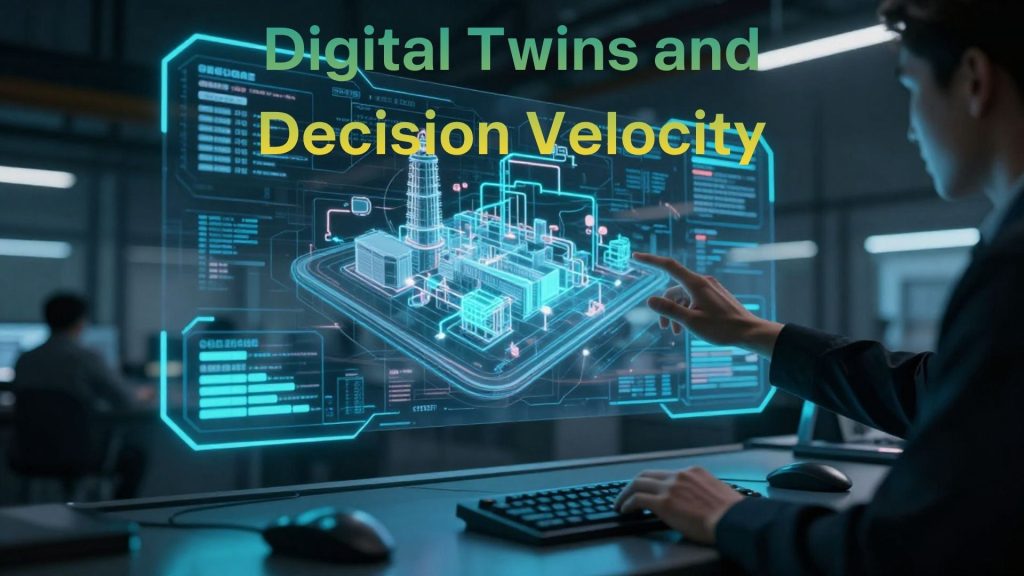
Walking the floor at Automate 2026, one theme dominated every conversation: digital twins are no longer a presentation slide. They are operational tools. Companies like Siemens, Microsoft Azure, and NVIDIA are shipping digital twin platforms that integrate real-time IoT data from factory floor sensors, not just CAD models. The shift is subtle but seismic. A few years ago, a digital twin was a static 3D model that engineers used for initial design validation. Now, it is a living simulation that mirrors the production line second by second. When a sensor on a stamping press reports unusual vibration, the twin updates its stress model in real time, predicts the probability of a failure within the next 48 hours, and recommends a maintenance window that minimizes production loss.
Investments in connected enterprise software, ERP, MES, and supply chain planning platforms have created the data infrastructure that makes digital twins possible. Without clean, structured data flowing from procurement through production to distribution, a digital twin is just a pretty visualization. The companies that invested in data maturity over the past five years are now the ones unlocking digital twin value. Everyone else is still cleaning spreadsheets.

The Wharton Challenge: Transparency Is a Competitive Weapon
While digital twins solve for operational efficiency, the Wharton School recently published a pointed reminder: technology means nothing if your supply chain is hiding forced labor. Their argument is not new in moral terms, but the framing is different. Wharton positions transparency not as compliance overhead but as a shipper’s strategic advantage. When a container vessel arrives at Rotterdam with goods from a factory that has been publicly accused of labor violations, the shipper (not the factory) bears the reputational and regulatory risk. Customs authorities in the EU and US are increasingly demanding documentation that traces raw materials to their origin. Digital twins can help. If a digital twin includes a bill-of-materials traceability layer that tracks each component back to its certified source, the shipper can produce verifiable documentation within hours, not weeks.
The message is blunt but practical: the technology to build transparent supply chains exists. The gap is not in the hardware or the software. It is in the maturity of data integration between suppliers, logistics providers, and the enterprise systems that govern them. Wharton calls for shippers to demand API-level visibility from their upstream partners, not PDF certificates sent by email. Digital twins that incorporate supplier data, labor compliance checks, and environmental metrics turn a compliance burden into a competitive differentiator.
Decision Velocity: The Metric That Matters
The third piece of the puzzle comes from an internal strategy document circulating among supply chain leaders, titled “DECISION VELOCITY.” Its core thesis: in an environment where disruptions arrive weekly, tariffs, port strikes, component shortages, weather events the speed at which an organization moves from data to decision to action is the only sustainable advantage. Inventory buffers can be replicated. Supplier relationships can be poached. Logistics contracts can be undercut. But an organization that can simulate three scenarios, evaluate trade-offs, and commit to a course of action in hours rather than weeks cannot be copied.

Digital twins are the engine of decision velocity. A live simulation of your supply chain, fed by real-time data from suppliers, logistics providers, and demand signals does three things that no static dashboard can. First, it allows decision-makers to run what-if scenarios without touching the actual production line. Second, it surfaces second-order effects that human intuition misses. Third, it reduces the psychological cost of decision-making because the simulation provides a safe sandbox to test outcomes before committing resources.
Software maturity is the prerequisite for all of this. A company running its supply chain on spreadsheets and email cannot build a digital twin. A company with fragmented ERP instances across business units cannot achieve decision velocity. The automation trends at Automate 2026, the transparency demands from Wharton, and the strategic framework of decision velocity all converge on one hard truth: the next competitive edge in manufacturing and supply chain is not a cheaper factory or a faster ship. It is software maturity, the ability to see, simulate, and decide faster than the disruption cycle.
The New Competitive Edge
The manufacturing supply chain is being rewired by three technology trends that reinforce each other: digital twins that turn static data into live simulations, transparency demands that require integrated data visibility, and a strategic focus on decision velocity that measures organizations by their response time. The companies that invested in software maturity over the past five years are now entering a phase where their data infrastructure becomes a competitive moat. Those that did not are facing a choice: build the digital foundation now, or accept that every disruption will hit harder and last longer than it should. In a world where geopolitical shocks, labor scrutiny, and technology cycles accelerate simultaneously, decision velocity is not a luxury. It is survival.