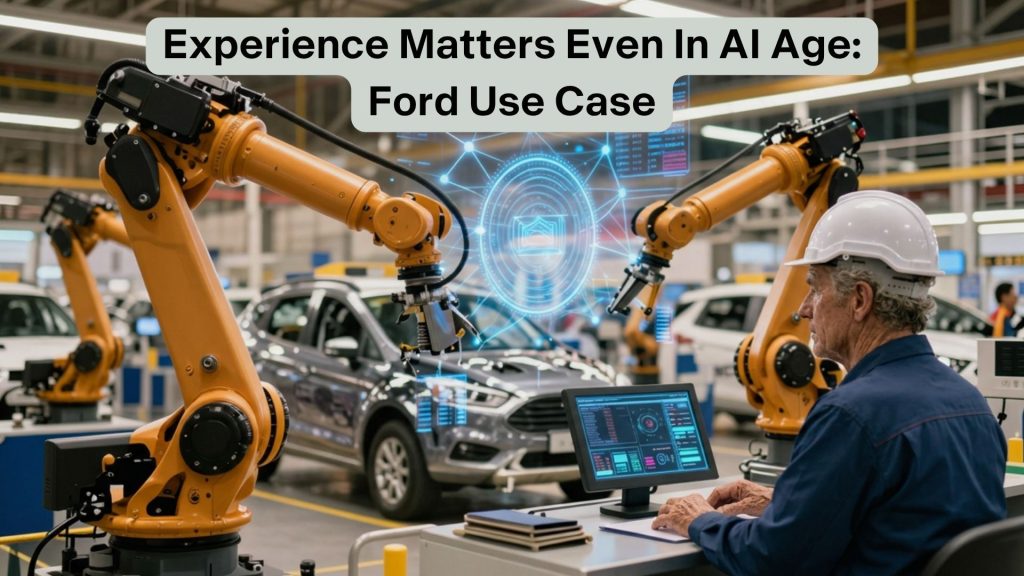
ord Motor Company recently hired 350 veteran engineers (some former employees, others drawn from suppliers) after artificial intelligence and automated quality systems failed to deliver the expected results. The company calls them “gray beard” engineers, and their return marks a significant moment for anyone in supply chain management.
Ford’s chief operating officer, Kumar Galhotra, told Bloomberg that the company had been “relying more and more on automated quality systems” with disappointing results. So Ford “brought back technical specialists,” and those specialists now “hunt for failure points before a part ever reaches the plant floor.”
Charles Poon, Ford’s vice president of vehicle hardware engineering, put it even more bluntly: “Mistakenly we thought that by just introducing artificial intelligence and ingesting the design requirements that we had, would produce a high-quality product.”

This is not an anti-technology story. Ford is not abandoning AI. The rehired engineers are training younger staff and reprogramming the AI tools themselves. But the episode reveals something deeper about the limits of automation in complex physical environments, a lesson every supply chain professional should absorb.
In supply chain, we have been sold a similar story: that AI will replace judgment, that algorithms will outperform experience, that a neural network trained on historical data can predict every disruption before it happens. The Ford case shows this is only half true.
An AI model can detect a pattern of defects across thousands of parts. It can flag an anomaly that a human eye would miss. But it cannot walk onto a plant floor, run a hand along a weld seam, and know, from 30 years of muscle memory that the cooling rate on that line is one degree too slow. That kind of tacit knowledge, the kind that lives in people who have touched the product, is not digitizable in any training set.
This gap between explicit data and tacit understanding is the real bottleneck in supply chain AI adoption. Most systems are built on the assumption that every relevant variable has a column in a database. But the most critical variables: supplier mood, regulatory whisper, market intuition exist only inside human heads. The gray beard engineers at Ford are not there because the AI failed entirely. They are there because the AI could not see what they see.
Ford’s experience maps directly to supply chain operations. Consider a demand planner who has watched the same category for two decades. They know that every July, two weeks before the national holiday, one specific distributor double-orders. The AI will flag the statistical outlier, but the human knows why it happens and how to respond without creating a bullwhip effect.
Consider the procurement manager who has built relationships with suppliers across three continents over 15 years. They know which vendor is padding a lead time, which factory manager responds to a phone call faster than an email, and which quality certification actually means something versus which one checks a box. That institutional knowledge does not appear in any ERP module.
This is where the “gray beard” concept becomes a supply chain strategy rather than just a manufacturing anecdote. The most valuable people in any supply chain organization are not necessarily the ones who can write the best Python script or deploy the fastest API. They are the ones who have seen the chain break in four different ways across three different economic cycles, and who know which lever to pull first.
Ford’s results speak for themselves. CEO Jim Farley said the rehiring lowered warranty and recall costs, “contributing to literally hundreds and hundreds of millions of dollars of a tailwind for Ford on cost.” The automaker also claimed the top spot among mainstream brands in the JD Power Initial Quality Survey published the same week.

The lesson is not that AI is useless. The lesson is that AI amplifies, it does not replace. A modern supply chain needs both: the algorithmic scale of machine learning and the pattern recognition of people who have lived through the patterns before. The companies that succeed will be the ones that understand which decisions belong to each side.
Ford’s gray beard engineers are not a nostalgia project. They are a correction. Every supply chain leader should ask: who are the gray beards in my organization, and am I listening to them before the AI-driven quality failure reaches the customer?
Because the cost of finding out afterward is measured in hundreds of millions and in lost trust that no algorithm can repair.