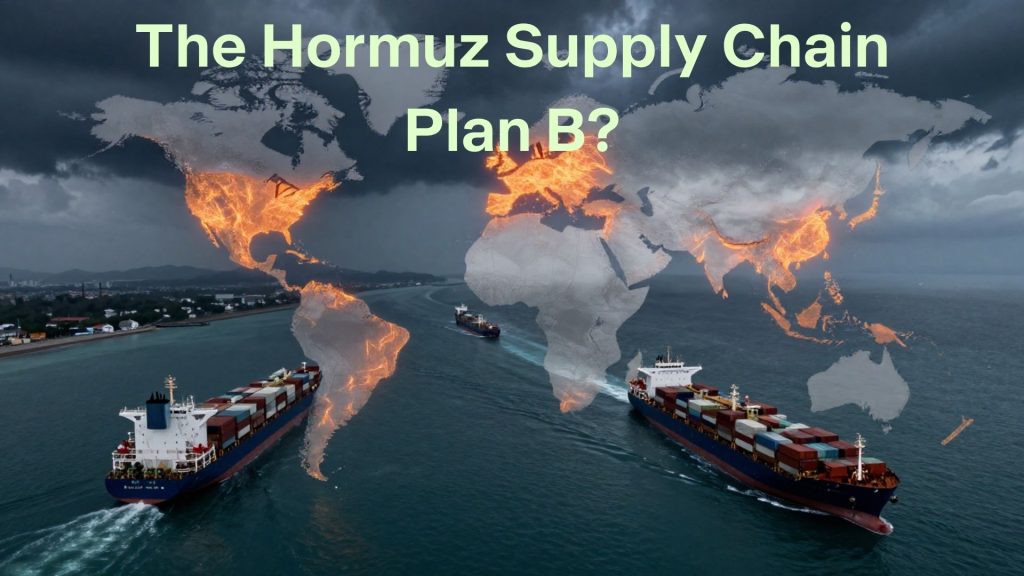
The Strait of Hormuz is a narrow passage connecting the Persian Gulf to the open ocean. About 21 miles wide at its narrowest point. And yet this sliver of water handles roughly one-fifth of the worlds daily oil consumption. When it is open, nobody thinks about it. When it is blocked, the entire global supply chain remembers how fragile it really is.
Over the past week, the Strait reminded us again. Ship traffic dwindled to almost nothing. Iran asserted that its corridor is the only legal route and that all vessels require its permission. For a brief window, about 24 hours, some ships managed to escape the Persian Gulf. Then the window closed. An Iranian attack on a commercial vessel shut it down again. Data from Al Jazeera tracking shows that only 48 vessels crossed between 26 and 28 June. Of those, 23 were oil and gas tankers, 7 were bulk carriers, and 19 were cargo or container ships.
Every supply chain professional now faces a brutal question: what is your Plan B when Hormuz is not an option? The answer, for most companies, is unsettlingly vague. Alternative routes exist. The land bridge through Saudi Arabia has been discussed for years. It is now being called the best option as confusion reigns over Hormuz transit authority. But a land bridge requires infrastructure, coordination, and time. When sanctions, shipping surcharges, and armed conflict have the final say on which ships move when, a theoretical alternative is not a plan. It is a hope dressed up as a strategy.
Carriers are already responding. Hapag-Lloyd has led the wave with Middle East Emergency Surcharges on container bookings from India to the Persian Gulf. These surcharges are designed to recoup operational costs from the unpredictability of navigating a conflict zone. But they also signal something deeper. The risk premium on Persian Gulf shipping is no longer a temporary calculation that disappears when headlines fade. It is becoming a structural cost of doing business in the region.
The geopolitical picture is shifting in real time. The United States and Iran have agreed to hold direct talks in Doha. Both sides agreed to halt strikes temporarily and allow ships to sail freely as technical negotiations resume. The 14-point memorandum of understanding signed on June 17 includes the removal of all US sanctions on Iran. This is a seismic shift in trade sanctions architecture. Banks that spent years building Iran sanctions compliance infrastructure must now reverse-engineer it. For procurement teams, the lesson is uncomfortable: sanctions that were considered permanent can be unwound overnight.
Oil prices responded immediately. Brent crude rose to 72.57 a barrel. That is not a panic spike. It is a slow burn. And slow burns are harder to hedge against because they do not trigger the automatic responses that protect a supply chain. They erode margins gradually until someone notices that the cost of moving goods through the region has doubled and there is no quick fix.
For supply chain managers, the real takeaway is about fragility. The Strait of Hormuz has been a known chokepoint for decades. Wars have been fought over it. Tankers have been attacked near it. Insurance premiums have spiked around it. And yet most supply chains still operate on the assumption that it will be open tomorrow. The companies that will emerge stronger are those that stop waiting for Hormuz to be stable and start building operations that assume it will not be.
That might mean diversifying energy sources away from Gulf-dependent supply chains. It might mean holding strategic inventories outside the region. It might mean investing in alternative routing before a crisis forces that investment. The cost of building redundancy is real. It appears on a budget line and does not generate revenue in stable times. But it is a fraction of the cost of being caught without it when the window closes again.
The Strait of Hormuz is the worlds biggest supply chain wildcard. It always has been. Pretending otherwise is no longer a viable strategy.