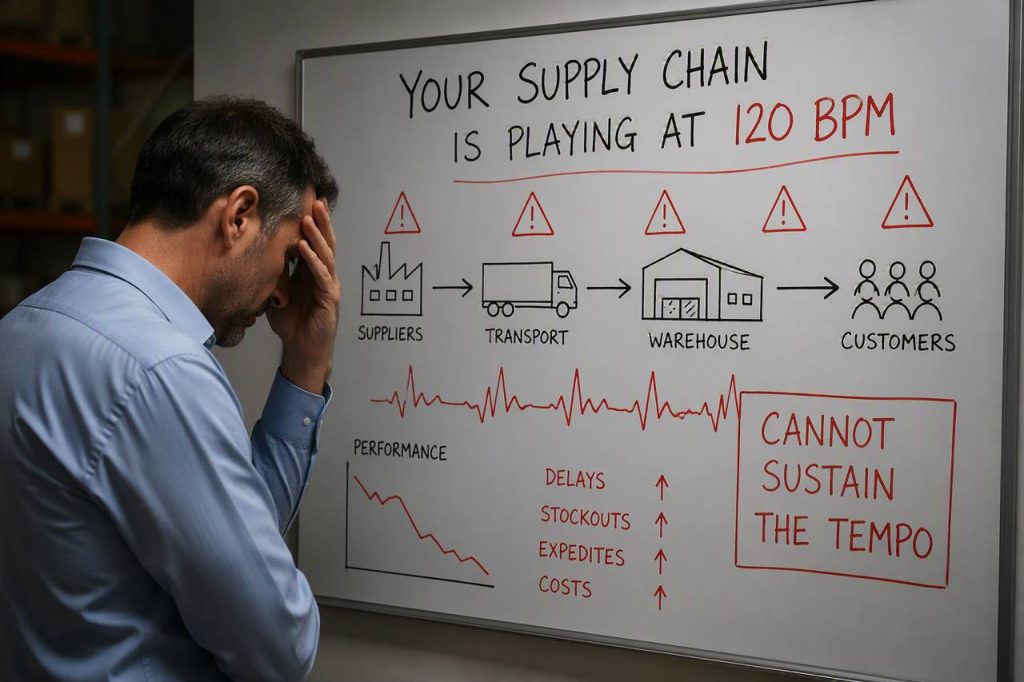
The human heart naturally settles at 60 beats per minute. When we hear music at that tempo, our pulse syncs with it. We calm down. When the tempo rises beyond our natural rhythm, so does our heart rate. We become alert, agitated, or anxious without knowing why. Sharon Heller documented this in Too Loud, Too Bright, Too Fast, Too Tight, and the principle applies far beyond sensory defensiveness in individuals. It describes what has happened to supply chain operations over the last decade.
Supply chains have been running at 120 beats per minute for years. Every disruption accelerated the rhythm. A factory shutdown in Shanghai spikes the pulse in Mexico City. A port strike in Hamburg triggers alarms in Istanbul. A container ship reroutes through the Cape of Good Hope, and eighteen dashboards light up across three continents. The pace is not sustainable. Teams are not slow or incompetent. They are overstimulated, responding to every alert as if it were a fire, because the system has no resting tempo.
The research on entrainment, the biological process by which our heart rate synchronizes with external rhythm, has a direct management analogue. When every signal in a supply chain screams at the same decibel level, the organization loses its ability to distinguish between a temporary fluctuation and a structural shift. The planner who sees twenty red alerts on a single screen does not process them. She scans. She guesses. She escalates everything because nothing stands out. The system has been tuned too loud, too fast, for too long.
What supply chains need is not more data. They need rhythmic structure. A healthy supply chain operates at a base tempo, with daily replenishment, weekly reviews, and monthly S&OP meetings, and only accelerates when a genuine exception exceeds a threshold. This is the musical equivalent of a 60 BPM baseline with occasional, intentional accelerations. The rhythm is predictable. The team knows when to expect peaks and when to recover.

Most supply chain technology does the opposite. It amplifies every signal. Real-time tracking, live dashboards, automated alerts, and mobile notifications are all designed to inform, but they collectively produce the equivalent of a room where every speaker plays a different song at maximum volume. The technology is not wrong. The architecture is. The system was built for maximum information, not minimum useful information. It was designed to show everything, not to filter what matters at the current tempo.
The principle of entrainment suggests a different design philosophy. Establish a base rhythm for each layer of the operation. The execution layer runs fast (machines, conveyors, sorters) but at a steady cadence. The planning layer runs at a moderate tempo, with daily order review, weekly capacity check, and monthly forecast revision. The strategic layer runs slow, with quarterly network reviews and annual supplier evaluations. Each layer has its own tempo, and they are designed to harmonize, not compete. When a disruption occurs, only the relevant layer accelerates. The others maintain their rhythm. The organization does not panic because the beat does not change for everyone at once.
Sales and operations planning, when done well, is exactly this. It is the 60 BPM baseline of the supply chain. The monthly cycle is predictable. The inputs are known. The participants know their role. The rhythm creates a container for calm analysis. Companies that run effective S&OP processes report fewer fire drills, better forecast accuracy, and lower team turnover. They are not working harder. They are working at the right tempo.

There is a practical test any supply chain leader can run. Open the alert dashboard. Count the number of notifications in the last hour. If the number exceeds the number of people on the supply chain team, the tempo is too high. The next step is not to hire more people. It is to tune the rhythm. Silence the alerts that do not require action within 24 hours. Redesign the weekly review so that it starts with the same five metrics every time. Create a monthly exception report that surfaces no more than three items requiring executive attention. Let the baseline tempo be predictable so that when the beat does accelerate, everyone notices.
Heller’s book is about sensory defensiveness, the state of being chronically overwhelmed by stimuli that others tolerate. It describes an individual condition. But organizations can be sensory defensive too. A supply chain that has been running at high tempo for years develops the same symptoms: irritability, avoidance of complex decisions, short-term fixes instead of structural improvements, and a constant low-grade anxiety that no single disruption caused. The cure is not suppression of information. It is structured rhythm. A heartbeat that knows when to slow down lasts longer than one that never rests.
The best supply chains are not the fastest. They are the most rhythmic. They know when to accelerate and when to return to baseline. They design their technology, their processes, and their team rhythms around the idea that constant high tempo degrades performance. They entrain, not race. And that may be the most important supply chain insight from a book that never mentions logistics once.