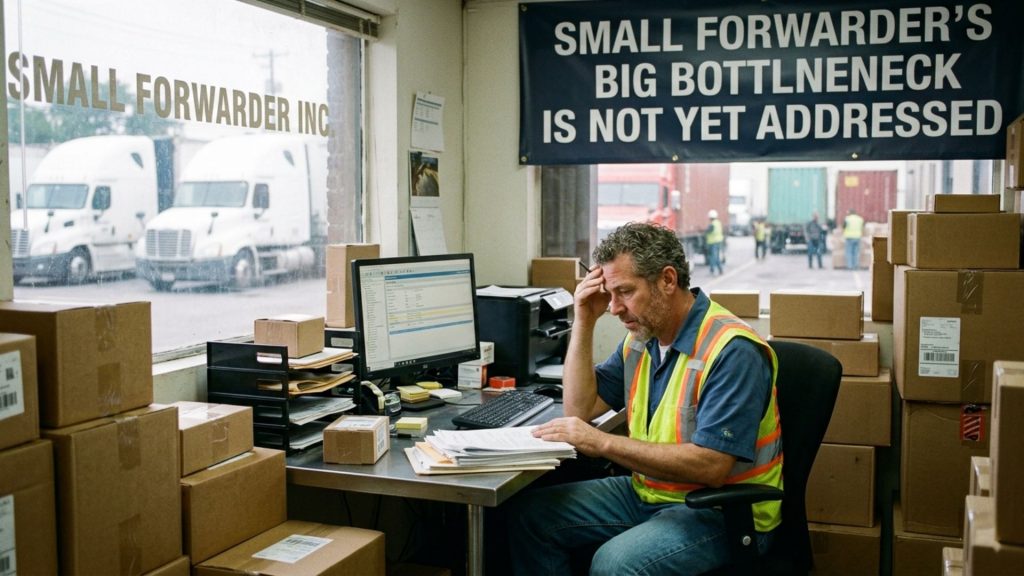
Ask anyone running a small or midsize freight forwarding operation what their biggest bottleneck is, and the answer will rarely be capacity or pricing. It is data. Every day, a handful of people manage an avalanche of emails, PDF rate sheets, spreadsheets, carrier portal logins, and manual data entry. The quote desk is where logistics meets chaos, and technology has done surprisingly little to fix it.
The demo version of artificial intelligence looks very different from the daily version. In the demo, AI ingests every document instantly, cross references rates across fifty carriers, and returns a perfect quote in seconds. In the daily version, the forwarding team still copies and pastes between windows, updates rate tables by hand, and hopes the email thread they are reading is current.
This gap is not a failure of AI itself. It is a failure of how the problem is framed. Most technology vendors sell a vision of total automation, when what the small forwarder really needs is something much more specific: a system that can handle the unstructured chaos of freight communication and turn it into usable data without requiring a full time IT team.
The recent bet by Starboard on smaller forwarders is interesting precisely because it acknowledges this reality. Instead of promising to replace the quote desk, Starboard focuses on the messy middle ground where data lives in formats that software cannot easily read. The insight is that the value is not in building a better algorithm. It is in creating a bridge between the unstructured world of emails and PDFs and the structured world of a forwarding system.
For a small forwarder, the cost of staying manual is not just wasted time. It is lost revenue. A quote that takes thirty minutes to prepare will not be prepared at all when the request comes during peak hours. A rate table updated weekly means the fifth quote of the week could be priced on stale information. A missed email asking for a lane quote turns into a missed sale that the sender assumes went to a competitor.
The stack of spreadsheets and carrier portals that fills the typical forwarder’s day is also a source of hidden margin erosion. When a human has to manually compare rates across multiple sources, the tendency is to default to the carrier whose pricing is easiest to access, not the one that offers the best value. Inefficiency favors the familiar, and familiarity costs money.

This is where AI that is built for the real operating environment, rather than the demo environment, can make a difference. The most useful AI tool for a small forwarder is not one that replaces the human decision maker. It is one that reduces the friction between receiving a quote request and presenting the best available option. That means reading emails, parsing attached rate sheets, checking live carrier portal data, and presenting a recommendation in a single interface.
The technology to do this exists today. What has been missing is the willingness to build for the specific constraints of the small forwarder: limited budget, no dedicated IT support, high variability in request types, and a workforce that is already stretched thin. The vendors that succeed will be those that treat the forwarder’s daily workflow as the product, not the AI model underneath it.
None of this means the quote desk is about to become fully automated. The best freight decisions still require human judgment, relationship awareness, and the kind of contextual knowledge that no algorithm can replicate. But the heavy lifting of data assembly, the part of the job that consumes the most time and generates the most errors, is ripe for a reset.
For the small forwarder, the question is no longer whether AI can help. It can. The real question is whether the tools being built are designed for the reality of the forwarding desk or for the conference stage. The ones that close that gap will earn their place in the daily workflow not by promising transformation, but by making the quote desk slightly less chaotic, one email at a time.