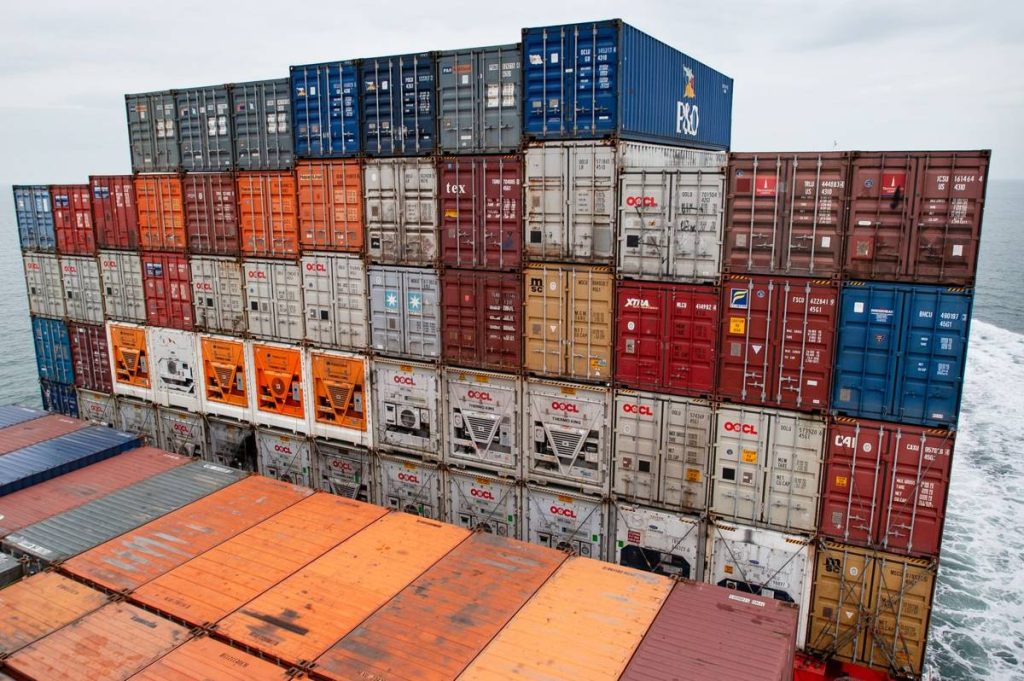
Your forwarder books the space, issues the bill of lading, and files the export paperwork. It is the most trusted middleman in your supply chain. And right now, US authorities are investigating one of the world’s biggest forwarders for allegedly helping move Nvidia AI servers toward China.
In May 2025, Nvidia’s chief executive insisted there was “no evidence of any AI chip diversion,” pointing out that a Grace Blackwell system weighs nearly two tons. You cannot put it in a pocket or a backpack. He was right about the backpack. He was wrong about the implication. Two tons fits easily inside a shipping container, and containers move through freight forwarders every day.
The forwarder in the crosshairs is Apex Logistics, a Singapore-based, wholly owned subsidiary of Kuehne+Nagel. The US Bureau of Industry and Security is examining 47 shipments Apex handled in 2024, allegedly linked to AI systems built by Super Micro Computer. If enforcement follows, it would be the first action against a freight transport company for suspected participation in the illegal semiconductor trade.
The core lesson is simple: export controls are only as strong as the weakest link in the freight chain, and that link is increasingly the forwarder.
Here is what makes the case uncomfortable for every shipper and forwarder. The suspected route was not exotic. Nvidia-powered servers moved from Taiwan to the United States, then to an Asian destination outside China, then to Hong Kong, where they were driven across the border into the mainland. Washington’s focus is on a single leg of that journey: exports from the US to Southeast Asia. One leg. That is how the investigation started.
The details that matter most involve paperwork. Each of the 47 shipments was labelled by two former Apex employees with a shipping code used to indicate the hardware was not subject to US export controls, according to people familiar with the matter. Both employees left shortly after Apex learned of the probe. False documentation is a recurring tactic across chip smuggling networks; in other cases, restricted Nvidia hardware was labelled as generic “computer servers.”
Apex says it was aware of US concern over “a small number of shipments” from 2024 “which may have involved materials and equipment which were ultimately forwarded to prohibited locations.” The company says it is cooperating fully and has introduced enhanced compliance procedures. It also points to a structural weakness that will sound familiar to anyone in logistics: it lacked full visibility into what was inside the shipments because it relied on codes and designations assigned by customers.
That is the part compliance teams should read twice.
The scale of the problem is not hypothetical. Washington restricted high-end AI chip sales to China in 2022 over military concerns, and the restrictions spawned a sophisticated shadow trade that authorities allege has moved billions of dollars’ worth of Nvidia chips into China. In a separate operation, the Department of Justice charged a network that exported at least $160 million worth of H100 and H200 GPUs between October 2024 and May 2025, using straw purchasers, domestic warehouses and rebranding. Seizures exceeded $50 million. The numbers matter because a hundred servers barely fill a corner of a data centre, while thousands could meaningfully shift the balance in a foundational part of the AI race.
The human story is the compliance manager who did everything right. The shipment was booked properly. The documents were filed. The customer was a known name. Months later, an investigator asks why your lane moved restricted hardware to a prohibited destination. “We did not know” is a true statement and a weak defense. Forwarders sit between customers who know what they ship and governments that want to know where it goes; that position used to be a comfortable one, and it no longer is.
Apex’s own trajectory shows how quickly the ground shifted. Founded in 2001, it transformed from a China-based logistics firm into a global freight forwarder serving retail, chemicals and aerospace. The investigation began while that evolution was still unfolding. Growth built the company; compliance is what will now define its next chapter. Kuehne+Nagel says it has not been contacted by the authorities, and Apex says it is cooperating. Singapore, where Apex is based, has said it will not tolerate firms using the city-state to circumvent other countries’ export controls.
The question for every shipper and forwarder is not whether your lane is clean today. It is whether your paperwork could survive a second look. Three questions worth asking this week:
Do you know what is actually inside the shipments you move, or are you trusting the customer’s code?
Which of your lanes touch restricted goods, transshipment hubs, or high-risk destinations?
If an investigator called tomorrow, would your files tell a story you can defend?
The chips did not cross borders in backpacks. They crossed in containers, with bills of lading, through perfectly ordinary supply chains. The industry assumption that forwarders are neutral middlemen just ended. The forwarder that treats compliance as a checkbox will eventually become a headline; the one that treats it as a core capability will become a trusted partner.