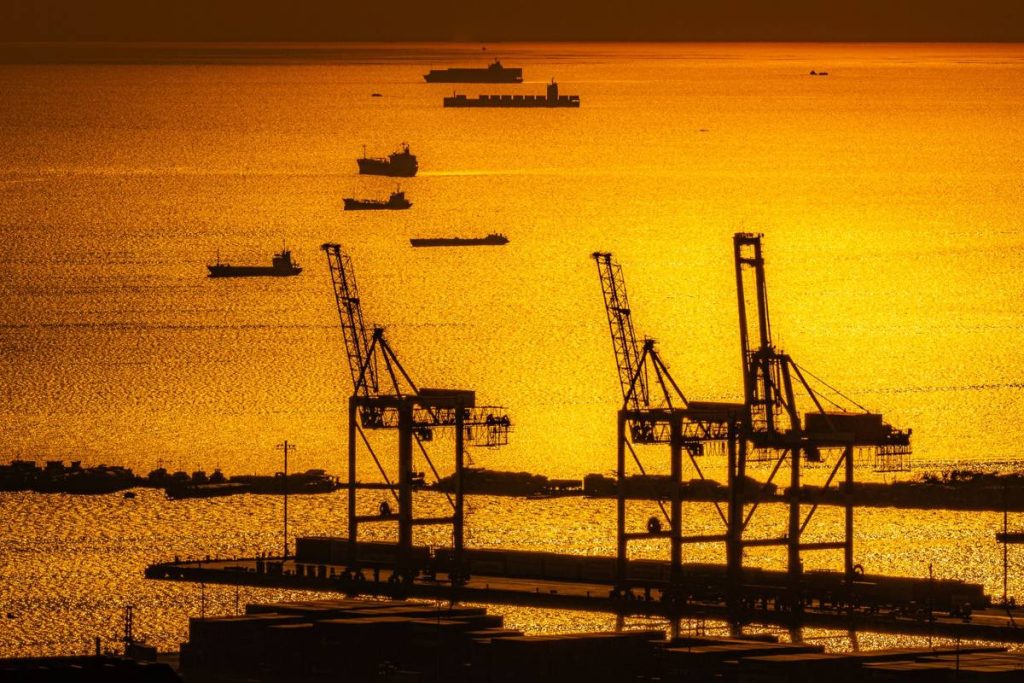
A terminal built to move boxes between ships has had to create something it was never designed to need: a road gate. There was no exit for trucks, yet movements rose from about 100 a day to 8,500 because containers could no longer continue by sea. The headline disruption is in big ships, but the planning split is in the small ships that connect hubs to everywhere else: capacity and vessels are leaving the Gulf, returning in other trades, one port is replacing another, and sea relay is giving way to overland trucking.
The Gate That Was Never Supposed to Exist
The bypass port outside the strait was built for transshipment, not for sending cargo inland. Its weekly throughput climbed from around 8,000 teu to 65,000 teu, about 700 percent, while its target is near 100,000 teu. That rise shows how quickly a maritime design can become a land transport operation when the expected relay fails.
A major line and its alliance partner relaunched their Far East to Middle East loop, but the rotation now calls at the port outside the strait instead of Jebel Ali. Volumes moving directly into the major Gulf hubs have fallen, and their transshipment business is expected to end. The network is changing where boxes are handed from one service to the next.
One operator has moved 500,000 teu through overland corridors into the Gulf since March and bought 700 more trucks for those landbridges. This substitutes for sea relay, but adds border formalities, truck availability, inland staging, road capacity and delivery appointments. A sea connection absorbed those interfaces inside a scheduled network. The landbridge exposes them to queues and coordination, so it costs time and complexity that sea relay did not.

The Fleet Moved and Nobody Announced It
The largest feeder operators moved in opposite directions within a single year. One contracted by 7.1 percent to a fleet of 182,776 teu. It cut Middle East capacity by 34.2 percent, while expanding intra Europe by 7.4 percent and intra Americas by 17.7 percent. It also joined a deepsea Asia to Europe service with a 4,800 teu ship, replacing lost regional density.
A state backed operator expanded capacity by 31 percent year on year and narrowed the gap with market leaders. Its feeder ships now provide the last regular container services through the strait on short loops connecting the Emirates with Pakistan and the west coast of India.
Another carrier removed 110,983 teu, more than half its available capacity, including 16 chartered ships returned after sanctions. It fell from 13th to 24th among the largest box lines before entering a new China to Mexico trade. None of this appears clearly in the headline rate story. The ships did not stop operating. They were re-pointed, leaving missing connections.
Insurance Did Not Get Expensive, It Left
War risk cover for a strait transit had been around 0.10 to 0.125 percent of vessel value, then rose to 2 to 3 percent, roughly 1,000 to 2,400 percent higher. One estimate put the peak near 5 percent. For a 100 million dollar vessel, one transit moved from about 250,000 dollars to between 375,000 dollars and 3 million dollars. Another assessment put cover at 7.5 to 10 percent of hull value in the strait, against 0.5 percent at the second chokepoint.

The more consequential shift is availability. Annual war risk policies are no longer written for the Gulf, so cover is bought voyage by voyage. Without the certificate, a vessel cannot obtain port entry and financing covenants can break. One line introduced a surcharge of 1,500 dollars per 20 foot equivalent and 3,500 dollars per reefer or special container, but a surcharge matters only when the voyage can be insured.
Marine insurers now price a permanently elevated baseline rather than switching between risk on and risk off. Insurance documentation is part of the movement plan: it can determine whether a vessel sails, whether a port accepts it and whether a connection survives. A financial control has become part of physical lead time.
What This Does to Your Lead Time
Contract and spot rates on the Asia to Middle East trade were up 130 percent year on year in August and at their highest level. Spot rates into the bypass port rose 479 percent from late February to early September, reaching 10,626 dollars per 40 foot box and passing the pandemic record. About 60 containerships were anchored at the southern entrance to the strait, while 122 merchant vessels were redirected.
The planning failure is not a rate problem. A route that once had one sea leg may now contain a sea leg, a road leg and a queue. The transshipment hub assumed in the plan may no longer be the hub, and the vessel named in the schedule may now be deployed in another ocean. A transit time can describe a route that no longer exists.
Derive lead times from the legs operating now, rather than adjusting last year’s number. Check whether the assumed relay port still handles the volume and the inland handoff still has manageable queues. Treat the insurance certificate as a lead time item because cover is issued voyage by voyage and can gate port entry. Pick one lane into the Gulf and rebuild its lead time from scratch this week, then compare it with the number in the plan.