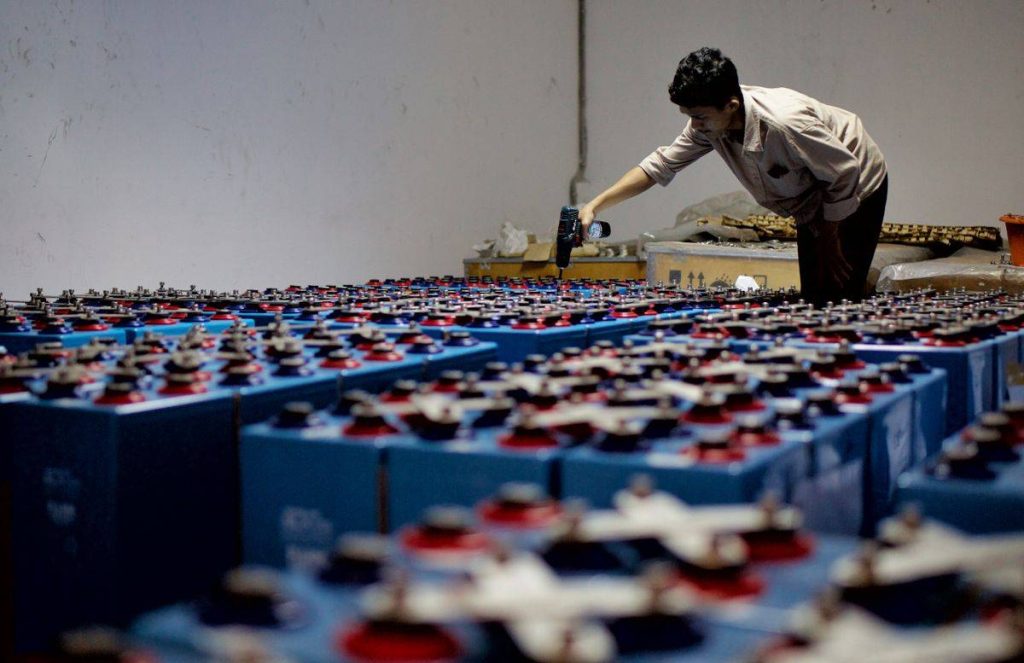
If you have ever changed the battery in a child’s toy, a TV remote, or a hearing aid in Europe, there is a strong chance you were holding a Varta. In 2022 alone, the company manufactured 3 billion battery cells. It was, for millions of European households, the anonymous power source inside everyday life. A 137-year-old German industrial icon. Last week, it filed for insolvency.
Varta’s insolvency is not an isolated corporate failure. It is a canary in the coal mine for Europe’s fragile battery supply chain, and a warning that strategic autonomy cannot be built on a single point of failure.

The insolvency filing lands at a particularly vulnerable moment. Europe has spent the past three years accelerating its push for strategic autonomy in critical technologies: semiconductors, rare earth processing, and, most visibly, batteries. The European Battery Alliance, launched in 2017, aimed to capture a $290 billion annual market by 2030. Gigafactories were announced from Sweden to Spain. Northvolt raised over $13 billion. Varta, with its 4,045 employees and 793 million euros in annual revenue, was supposed to be part of that backbone. Its collapse punctures the narrative.
The concentration risk in battery supply chains is not theoretical. Global battery cell production is dominated by a handful of Asian manufacturers. CATL alone controls roughly 37 percent of the global market. LG Energy Solution and BYD account for another 25 percent combined. Europe’s domestic production capacity, despite years of investment and policy support, remains a fraction of what Asia produces annually. When a flagship European player fails, the dependency deepens, not by choice but by default. Automotive OEMs that had qualified Varta as a domestic supplier now face a scramble for alternatives, most of which sit thousands of kilometres to the east.

The creditor dynamics add another layer of complexity. Deutsche Bank and a consortium of lenders now hold significant sway over Varta’s restructuring, or its carve-up. Porsche, which acquired a 32 percent stake during the 2024 restructuring, watches from the sidelines. The question is not simply whether Varta survives. It is whether its assets, its intellectual property, and its production lines remain under European control, or are acquired by competitors with deeper pockets and different strategic interests.
This is not a hypothetical concern. When Britishvolt, the UK’s flagship battery startup, collapsed in 2023, its Australian owner has yet to deliver on production promises. The site in Northumberland remains undeveloped. The pattern is consistent: ambition announces itself loudly; execution arrives quietly, if at all.
Consider the people inside the numbers. Varta’s 4,045 employees are not an abstract workforce. They are engineers who spent careers mastering the electrochemistry of lithium-ion cells. Technicians who know the calibration tolerances of production lines that took years to perfect. Quality specialists who understand why one batch of batteries lasts five years and another fails in six months. When a company with 137 years of accumulated knowledge collapses, that knowledge does not transfer neatly to a spreadsheet. It scatters. Some of it retires. Some of it moves to Asia, where competitors are eager to absorb it. Very little of it stays in one place waiting to be reassembled. Europe is not just losing a manufacturer. It is losing the human infrastructure of an industry.
The implications extend beyond automotive supply chains. Energy storage projects across Europe depend on a reliable, cost-competitive supply of battery cells. Grid-scale storage, home battery systems, and industrial backup power all require the same technology Varta produced. A narrowing supplier base means higher prices, longer lead times, and increased vulnerability to geopolitical disruption.
The lesson is not that Europe should abandon its battery ambitions. It is that those ambitions must be built on a broader base. No single company, no single factory, no single technology should carry the weight of strategic autonomy. The path forward requires more companies, not fewer; more production locations, not larger ones; more redundancy, not more efficiency.
For supply chain leaders, the Varta case is a prompt to ask three uncomfortable questions. First: how many of your critical suppliers are one insolvency filing away from disrupting your operations? Second: how many of those suppliers are domestically strategic but financially fragile? Third: what is your alternative, and have you qualified it, or just listed it?
The European battery industry will survive this. It may even emerge stronger. But Varta’s insolvency should be remembered not as an anomaly, but as an early warning. Strategic autonomy is not declared from Brussels. It is built, one supplier, one production line, one balance sheet at a time. And when one of those balance sheets breaks, the entire strategy feels the tremor.