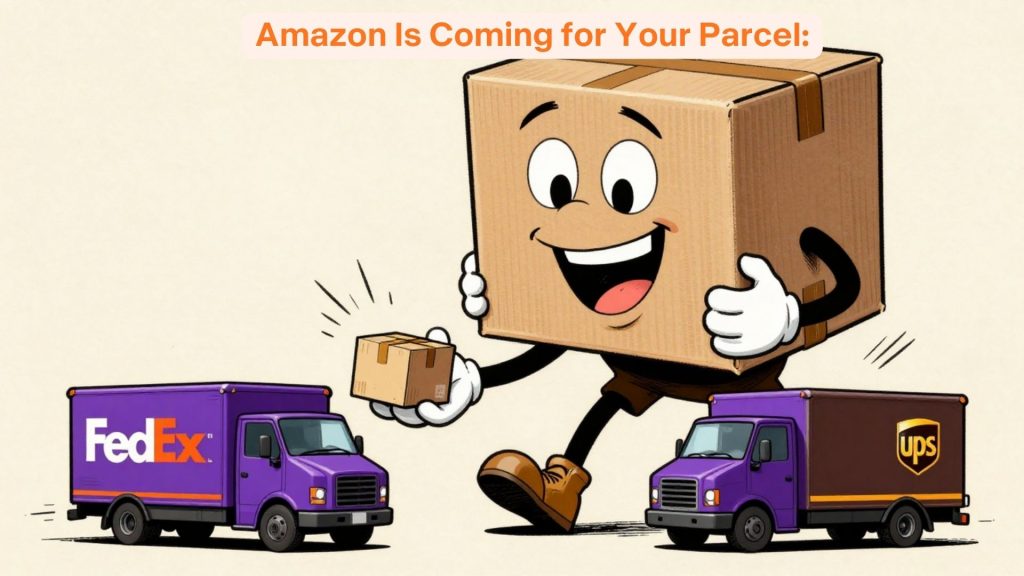
Imagine this: You are a shipping manager at a mid-sized manufacturer. Your FedEx bill just jumped 12 percent because of fuel surcharges. UPS is raising rates again. And Amazon, the company that your customers order from, just offered to deliver your outbound parcels for less than either carrier. That call is already happening in procurement offices across America.
Amazon shipped more than 4.8 billion parcels in the United States in 2024, surpassing UPS for the first time and closing fast on FedEx. The company that started as an online bookstore now operates a delivery network that rivals, and in some segments surpasses, the two incumbents that have dominated American parcel logistics for decades.
The Numbers Tell a Stark Story
FedEx and UPS collectively lost parcel volume in 2024 even as e-commerce grew. Shippers are defecting, driven by relentless fuel surcharge increases that the TD Cowen/AFS Freight Index shows hit their highest sustained levels since 2022. Fuel surcharges alone added an estimated $1.2 billion in costs to US shippers last year, and those costs show no sign of easing.
Meanwhile Amazon’s shipping costs per package continue to fall as its network densifies. The company’s logistics arm, Amazon Shipping, now actively solicits third-party business, offering rates that undercut FedEx and UPS by 20 to 30 percent on certain lanes. For shippers battered by surcharges, the math is brutal and simple.
Amazon’s Infrastructure Bet Is Paying Off
Amazon spent over $100 billion on logistics infrastructure between 2019 and 2024. That investment bought sorting centers, air hubs, a fleet of cargo aircraft, and a last-mile delivery network of more than 200,000 drivers. Where FedEx and UPS must maintain profitability across their entire networks, Amazon can subsidize its delivery operation with the margin from AWS, advertising, and e-commerce marketplace fees.
The result is an asymmetric competitive threat. When Amazon loses money on a parcel, it gains market share and makes it up on the marketplace transaction fee. When FedEx or UPS loses money on a parcel, it goes straight to the bottom line.
Fuel Surcharges Are the Breaking Point
The TD Cowen/AFS Freight Index data reveals that ground fuel surcharges for FedEx and UPS averaged over 40 percent of base rates for most of 2024. For a typical $10 parcel, that means $4 in surcharges on top of the base rate. Amazon, by contrast, structures its pricing more transparently and absorbs a larger share of fuel cost fluctuations through its integrated supply chain.
Shippers are reaching a breaking point. Parcel consultants are fielding record numbers of inquiries about shifting volume to Amazon’s network. One logistics executive put it bluntly: “We are paying FedEx and UPS more every quarter for the same service. Amazon is offering us a way out.”

The Last Mile Is Where It Matters Most
Last-mile delivery represents more than 50 percent of total parcel shipping costs. It is also the segment where Amazon has invested most aggressively. The company’s same-day delivery network now covers more than 120 US metropolitan areas, and its weekend delivery penetration exceeds both FedEx and UPS in major markets.
For FedEx and UPS, the challenge is structural. Their networks were designed for a world where residential delivery was a small fraction of volume. Today residential parcels account for more than 60 percent of all deliveries, and the density economics favor a carrier that was built for e-commerce from the ground up.
What Maersk’s $100 Million Bet Tells Us
Maersk’s decision to open a $100 million fulfillment hub in Massachusetts signals something important. The world’s largest ocean carrier sees the same opportunity that Amazon does: the integration of warehousing, fulfillment, and last-mile delivery. In a market where every point of friction adds cost and delay, companies that control more links in the chain win.
Amazon’s advantage is that it already owns the chain from warehouse door to customer doorstep. FedEx and UPS, despite their scale, are primarily transportation companies in a market that increasingly rewards end-to-end control.
The Human Cost of the Shift
Behind the market share numbers are real consequences. Delivery drivers for FedEx and UPS face uncertainty as contract volumes decline. Small businesses that built their operations around FedEx Ground or UPS rates are scrambling to renegotiate. And procurement managers who have relied on the same carriers for decades are making the uncomfortable but necessary decision to switch.
For one logistics director at a Midwest consumer goods company, the moment came when her quarterly FedEx bill hit $2.3 million, up from $1.7 million the year before, with no change in volume. “I could not explain that to my CFO,” she said. “Amazon gave me a number I could defend.”
What Comes Next
FedEx and UPS are not standing still. Both carriers are restructuring their networks, cutting costs, and pushing into smaller markets where Amazon’s density is lower. But the trajectory is clear. Amazon’s parcel volume continues to grow at double-digit rates while the incumbents fight to hold flat.
The question is not whether Amazon will take significant parcel market share from FedEx and UPS. It already is. The question is how fast, and whether the incumbents can adjust their cost structures quickly enough to compete with a company that can afford to lose money on every package and still win.
For shippers watching these dynamics unfold, the message is simple: if you have not benchmarked Amazon Shipping against your current carrier contracts, the time to start is now. The fuel surcharge era is making every other carrier more expensive, and Amazon is ready to pick up the pieces.
Are your parcel rates competitive? Run the comparison before your CFO does.