
Why Cross-Functional Literacy Is the New Competitive Advantage
Supply chain management has spent decades living in the back office. It was the function that quietly kept shelves full, factories running and shipments moving. It is invisible when things went well and suddenly everyone’s problem when things fell apart. That era is over. The disruptions of the last five years, from global pandemics to geopolitical shocks and climate-related bottlenecks, have permanently changed how organizations must think about their supply chains. The supply chain is no longer a support function. It is a strategic asset. And here is the uncomfortable truth that most businesses still have not fully internalized: a supply chain is only as strong as the weakest decision made outside of it.
The Hidden Cost of Supply Chain Ignorance Across the Business
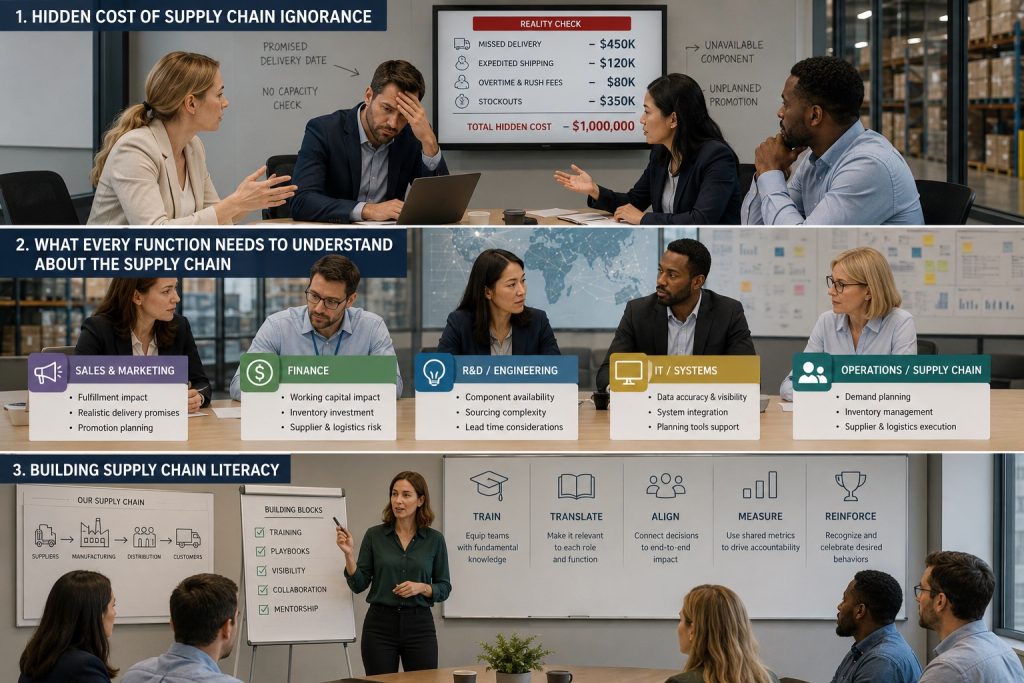
Every day, in organizations around the world, decisions are made that quietly undermine supply chain performance. A sales team promises a delivery date without checking manufacturing capacity. A product development team designs a component that no single supplier can reliably source. A marketing team launches a promotion without flagging the inventory implications. None of these actions are malicious. They are simply the result of teams operating in functional silos, optimizing for their own KPIs without understanding how their choices ripple across the end-to-end supply chain.
This is not a niche problem. It is one of the most common sources of avoidable cost, service failures, and missed growth opportunities in modern businesses. The root cause is straightforward: most non-supply chain professionals have never been given the tools to understand how supply chains work, what trade-offs they involve, and why decisions made far from the warehouse floor can trigger disruptions that cascade all the way to the customer.
Supply chain concepts like lead time variability, safety stock, the bullwhip effect and OTIF are not mysterious. They are learnable. But they require exposure, shared language, and deliberate investment in cross-functional education. Without that investment, organizations will keep paying the same avoidable price.
Supply Chain Is a Strategic Lever
One of the most important mindset shifts any leadership team can make is to stop treating supply chain management as a cost center and start recognizing it as a source of competitive advantage. The evidence is everywhere. Companies like Apple, Amazon, Procter and Gamble, and Unilever have built durable market positions not just through product innovation or brand strength, but through genuinely superior supply chain capabilities.
Supply chains create competitive advantage across multiple dimensions. They enable revenue growth by ensuring product availability and accelerating time to market. They build resilience by creating redundancy in sourcing and distribution networks, so that when disruptions hit, the business can absorb the shock rather than being paralyzed by it. They drive sustainability progress through smarter network design, responsible sourcing, and reduced waste. They improve capital efficiency by optimizing inventory deployment and working capital cycles. And they directly shape brand reputation, because consistent service and ethical sourcing are increasingly what customers and partners use to evaluate a company.
When supply chain leaders can articulate this full spectrum of value, the conversation shifts. Supply chain stops being a function that asks for budget and starts being a function that generates returns.
What Every Function Needs to Understand About the Supply Chain
Building supply chain literacy across an organization does not mean turning every sales manager or finance director into a logistics expert. It means equipping each function with enough understanding to make decisions that do not inadvertently harm the supply chain or miss opportunities to strengthen it.
There are fundamentals that every professional should know, regardless of their role. Lead times determine when products can realistically be delivered, which shapes what promises can be made to customers. Inventory is a buffer against uncertainty, but holding excess inventory ties up capital that could be deployed elsewhere. Forecast accuracy matters enormously because poor forecasts amplify the bullwhip effect, turning small demand signals into large, costly fluctuations upstream. And every supply chain decision involves trade-offs between cost, service level, and risk that rarely have a simple right answer.
Beyond the universal fundamentals, each function has its own specific blind spots. Sales and marketing teams need to understand the fulfillment consequences of promotions and the realities of what the supply chain can reliably deliver before committing to customers. Finance teams need to connect inventory decisions to working capital and understand how supplier terms and logistics choices affect risk exposure. Research and development teams must factor in component availability, sourcing complexity, and lead times when making design decisions, because a technically brilliant product that cannot be reliably manufactured at scale creates enormous downstream problems. IT functions play an increasingly critical role in ensuring that planning tools, ERP systems, and data structures support supply chain visibility rather than undermining it.
Building Supply Chain Literacy
Supply chain leaders who want to raise awareness across their organizations often make the mistake of waiting for others to come to them. The reality is that if supply chain wants a seat at the table when cross-functional decisions are being made, supply chain professionals must take the initiative to make their domain more accessible and more relevant to their colleagues.
The starting point is an honest assessment of where the organization currently stands. Most companies have pockets of genuine cross-functional engagement alongside significant blind spots where supply chain considerations are simply not part of the conversation. Mapping this landscape by function helps identify where targeted interventions will have the greatest impact.
Short, practical training programs are often the most effective first step. The key is to make the content relevant to the audience. A sales director does not need a lecture on logistics theory. They need to understand, concretely, how promising a non-standard delivery window affects capacity planning and inventory levels. When supply chain education speaks the language of the audience’s own goals and KPIs, it lands very differently than abstract operational concepts.

Playbooks and reference tools that translate supply chain principles into role-specific guidance can sustain awareness between formal training sessions. Visual dashboards that compare customer commitments against operational reality make trade-offs tangible in real time, surfacing tensions before they become crises rather than after. Cross-functional workshops embedded in strategy sessions help break down silos by creating shared experiences around real business challenges.
Mentorship is another underutilized lever. Pairing supply chain leaders with high-potential professionals from sales, finance, or R&D creates informal learning channels that build empathy and lasting cross-functional relationships. These connections pay dividends long before any problem appears in a KPI report.
Making the Change Stick
Awareness without accountability eventually fades. For cross-functional supply chain literacy to create lasting value, it must be reinforced through the performance management systems that actually shape behavior. As long as sales is measured purely on volume, finance on cost reduction, and R&D on speed to market, each function will naturally optimize for its own scorecard, sometimes at the expense of the broader system.
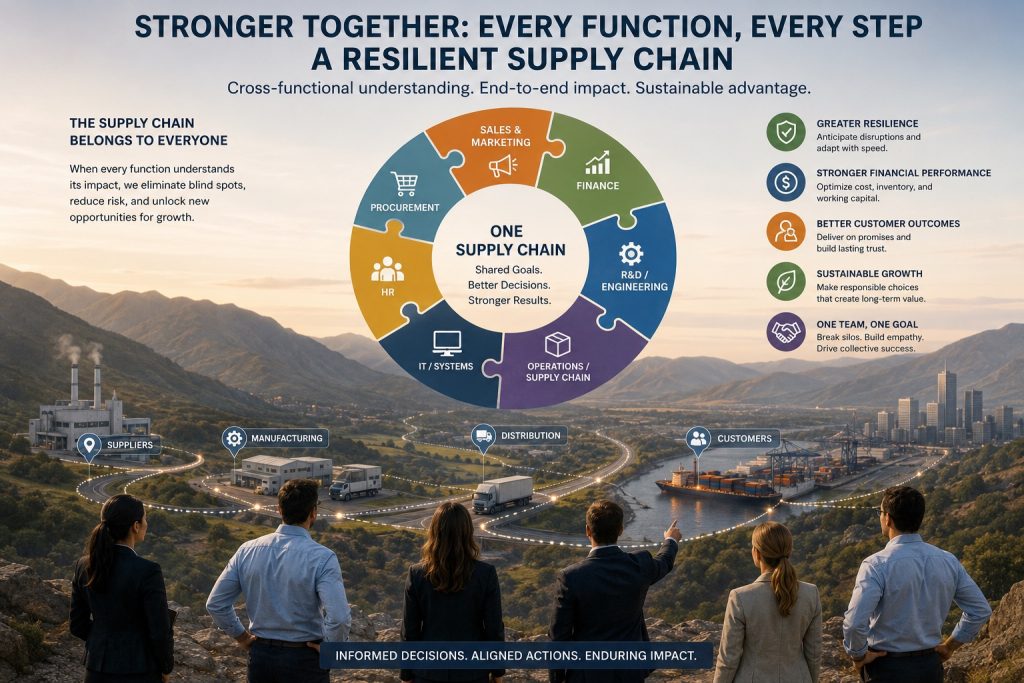
When organizations introduce shared end-to-end metrics, such as cost to serve, working capital efficiency, or on-time in-full delivery, cross-functional collaboration becomes structurally motivated rather than dependent on individual goodwill. Recognizing and celebrating supply chain-savvy behavior from outside the supply chain function sends a powerful cultural signal: understanding the supply chain is valued here, and it matters for career progression.
Post-mortems of both supply chain failures and successes, conducted transparently across functions, are one of the most effective tools for building organizational learning. When a promotion creates a stock-out, the conversation should not stay within the supply chain team. It should involve sales, marketing, and finance, because the next promotion will be planned by the same people and the same blind spots will resurface unless they are addressed together.
The Business Case Is Clear
Organizations that invest in supply chain literacy across all functions do not just avoid problems. They unlock value that was previously hidden inside functional silos. Fewer costly reworks. Fewer emergency logistics decisions. More realistic commitments to customers. Faster responses to market changes. Better capital efficiency. Stronger supplier relationships built on realistic planning rather than reactive firefighting.
In today’s environment, where supply chain volatility is a permanent feature rather than a temporary disruption, cross-functional supply chain understanding is not a nice-to-have. It is a competitive necessity. The companies that recognize this and act on it will be better positioned to grow, adapt, and win. The ones that treat supply chain as someone else’s problem will keep paying the price of that assumption, one avoidable disruption at a time.
The supply chain belongs to everyone. It is time to start acting like it.